In industrial ventilation, “99% capture efficiency” often appears as a reassuring number. On paper, it suggests that harmful fumes, particles, and gases remain under control. However, in real robotic welding environments, this figure is rarely the end of the story. In fact, it is often only the starting point.
Robotic welding units operate under conditions far more complex than laboratory test scenarios. Welding methods vary. Workpieces differ in size and geometry. Automation lines evolve, adding conveyors, safety enclosures, and collaborative robots. Under these dynamic conditions, fumes do not behave predictably. They drift, swirl, accumulate in corners, or escape through small gaps created by motion and heat.
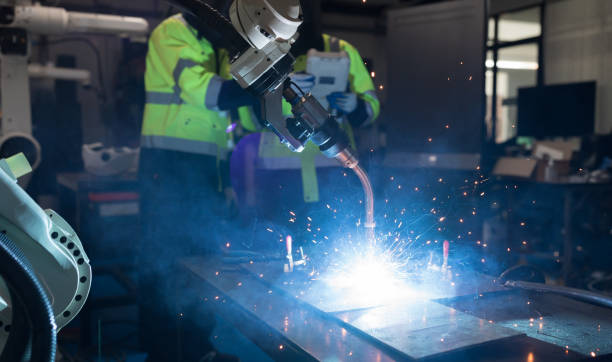
For industrial fume control suppliers like PURE-AIR, true performance means more than quoting product parameters. It requires an engineering mindset that treats fume capture as a system-level challenge. Especially in robotic welding cells, effective smoke and fume management depends on how source capture methods, airflow paths, and overall line layout work together as a unified solution.
This article explores how to design “no-blind-spot” fume capture solutions for robotic welding units. From arc welding to laser welding, from compact components to oversized assemblies, and from standalone cells to fully automated production lines, we will examine how systematic engineering turns fume control systems into truly reliable production tools.
Why “99% Capture Efficiency” Can Be Misleading
Capture efficiency figures usually come from controlled tests. Manufacturers measure airflow rates, filter performance, and particle removal under idealized conditions. While these parameters matter, they rarely reflect the realities of robotic welding.
In actual production, welding fumes rise due to thermal buoyancy, spread laterally because of robot motion, and interact with surrounding airflow from cooling fans, conveyors, and doors. Even a high-performance fume control system can underperform if the capture hood sits too far from the emission source or if airflow patterns conflict with the natural movement of smoke.
Moreover, robotic welding often involves continuous motion. The torch changes orientation. The weld seam moves along complex paths. As a result, the fume source itself is dynamic. A fixed capture point that works well at one moment may become ineffective seconds later.
Therefore, focusing solely on a percentage number oversimplifies the problem. Real effectiveness depends on whether the system captures fumes consistently, across all positions, cycles, and operating conditions. Achieving that consistency requires engineering beyond product specifications.
Understanding Fume Behavior in Robotic Welding
Before selecting equipment, engineers must understand how fumes behave in different welding processes. Arc welding and laser welding, for example, generate fumes with distinct characteristics.
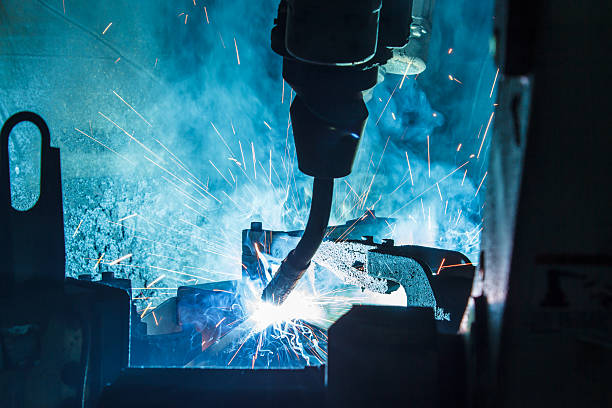
In arc welding, fumes consist of fine metal particles, shielding gas residues, and thermal plumes. The heat generated by the arc creates strong upward airflow, carrying fumes vertically before they spread outward. If capture systems fail to intercept this plume near the source, fumes quickly disperse into the enclosure.
Laser welding, by contrast, produces highly concentrated but localized fumes. The plume may rise less dramatically, but it often travels at higher velocity due to vaporization effects. In enclosed laser cells, fumes can rebound off walls and accumulate in unexpected areas.
In both cases, robotic motion further complicates the picture. Each axis movement alters airflow patterns. Therefore, engineers must treat fume capture as a dynamic challenge rather than a static one.
Source Capture: The Foundation of No-Blind-Spot Design
Effective fume control always begins at the source. Source capture minimizes the distance fumes travel before extraction, reducing dispersion and improving efficiency. However, “source capture” does not mean a single universal solution.
Top-Extraction Hoods
Top-extraction hoods work well when fumes naturally rise and when the welding zone remains relatively fixed. In robotic arc welding cells handling medium-sized workpieces, overhead capture systems often provide consistent performance.
However, top hoods must account for robot reach and torch angles. If the hood sits too high to avoid collisions, capture efficiency drops sharply. Engineers must carefully balance safety clearance with proximity to the fume plume.
Side-Arm Extraction Systems
Side-arm extraction offers flexibility for complex weld paths. Adjustable extraction arms can follow the robot’s operating envelope, capturing fumes from different angles. This approach works particularly well in cells where weld seams run horizontally or diagonally.
Yet side extraction introduces its own challenges. Improper placement can create cross-drafts that push fumes away from the hood. Therefore, airflow direction and velocity must align with the natural plume movement.
Integrated Torch Extraction
In some robotic welding applications, extraction directly at the torch provides the most precise source capture. By removing fumes immediately as they form, this method minimizes dispersion entirely.
However, integrated extraction systems increase system complexity. They require careful coordination between torch design, hose routing, and centralized fume control systems. Engineers must ensure that added weight and stiffness do not interfere with robot motion or weld quality.
System-Level Airflow Design: Beyond Individual Components
Even the best capture hood fails if the overall airflow system lacks coherence. True no-blind-spot performance emerges only when engineers design airflow as a continuous path from the emission source to the filtration unit.
Airflow Balance and Velocity Control
Air velocity at the capture point determines whether fumes enter the system or escape into the environment. Too little velocity allows dispersion. Too much velocity may disturb the welding process or draw in excessive ambient air.
Engineers calculate optimal capture velocities based on welding type, fume density, and enclosure size. They then balance airflow across multiple capture points to ensure uniform performance. In robotic welding lines with multiple cells, this balancing becomes especially critical.
Duct Routing and Pressure Management
Duct design directly influences system efficiency. Sharp bends, sudden expansions, or poorly sized ducts increase pressure losses, reducing effective airflow at the capture point.
Professional industrial fume extraction systems use smooth transitions, gradual bends, and properly sized ducts to maintain stable pressure. By optimizing duct routing early in the design phase, engineers prevent hidden performance losses that no filter upgrade can compensate for later.
Avoiding Dead Zones
Dead zones form where airflow stagnates. In robotic welding enclosures, these zones often appear behind fixtures, under conveyors, or near enclosure corners. Fumes trapped in dead zones eventually escape when doors open or robots move.
Engineers eliminate dead zones by introducing auxiliary capture points or guiding airflow with baffles. This approach ensures that every part of the enclosure participates in the overall airflow pattern.
Adapting to Different Workpiece Sizes and Layouts
Robotic welding lines rarely handle identical parts indefinitely. Manufacturers frequently change product dimensions, fixtures, or takt times. A rigid fume capture design struggles under these evolving conditions.
Small and Medium Workpieces
For compact components, enclosures allow tight control over airflow. Engineers can design semi-enclosed cells where airflow moves predictably from intake to exhaust. In these cases, smaller fume control systems integrated into the cell often provide sufficient capacity.
Large and Oversized Assemblies
Large workpieces introduce significant challenges. They disrupt airflow, block capture paths, and create complex shadow zones. Overhead extraction alone rarely suffices.
Engineers often combine multiple source capture methods for oversized parts. Side extraction arms, floor-level inlets, and strategically placed top hoods work together to ensure full coverage. This layered approach reflects true system-level thinking.
Flexible Production Lines
In highly automated lines with conveyors and multiple robots, fume control systems must adapt without frequent reconfiguration. Modular ducting, adjustable capture points, and scalable industrial dust collectors allow systems to evolve alongside production demands.
The Role of Filtration in System Performance
While capture and airflow design determine whether fumes reach the system, filtration determines what happens next. High-quality filters protect workers, equipment, and the environment.
Modern fume control systems use multi-stage filtration. Pre-filters remove larger particles, extending the life of the main filters. HEPA filters capture fine particulate matter, while activated carbon filters adsorb harmful gases and odors.
However, filtration performance depends on consistent airflow. If pressure drops rise due to clogged filters or poor duct design, capture efficiency declines. Therefore, advanced systems integrate differential pressure monitoring and intelligent alarms.
By linking filtration performance to overall system design, engineers ensure that capture efficiency remains stable over time, not just on day one.
Automation, Intelligence, and Real-Time Control
As robotic welding becomes more intelligent, fume extraction systems must follow suit. Static systems cannot respond effectively to dynamic production environments.
Sensor-Based Control
Modern industrial fume extraction systems use sensors to monitor airflow, pressure, and particulate concentration. These sensors feed data into control units that adjust fan speeds and dampers in real time.
For example, when a robot enters a high-fume welding cycle, the system increases extraction capacity. During idle periods, it reduces airflow to save energy. This adaptive behavior improves both performance and efficiency.
Integration with Production Systems
Advanced solutions integrate fume extraction controls with robotic controllers and manufacturing execution systems. This integration allows fume control to align with actual production states rather than fixed assumptions.
From a product perspective, this level of integration transforms fume control systems from standalone devices into intelligent subsystems within the broader automation architecture.
Engineering Capability as the True Differentiator
Many suppliers can offer high airflow fans, efficient filters, or robust housings. Fewer can design complete solutions that perform reliably under real production conditions.
Engineering capability shows itself in how suppliers analyze customer processes, simulate airflow behavior, and adapt solutions to unique layouts. It also appears in how systems accommodate future changes without requiring a complete redesign.
For PURE-AIR, product value lies not only in hardware quality but also in the engineering logic behind each solution. By approaching fume capture as a system rather than a component, industrial fume extraction equipment becomes a strategic asset rather than a compliance tool.
Long-Term Value of No-Blind-Spot Fume Capture
When robotic welding units achieve true no-blind-spot fume control, manufacturers experience benefits that extend beyond regulatory compliance.
Air quality improves consistently, reducing health risks and enhancing operator confidence. Equipment remains cleaner, lowering maintenance requirements. Production becomes more stable because fumes no longer interfere with sensors, optics, or robot motion.
Over time, these advantages translate into higher uptime, lower operating costs, and greater process reliability. From an investment perspective, well-engineered fume control systems deliver measurable returns throughout the production lifecycle.
Conclusion: From Numbers to Engineering Reality
“99% capture efficiency” may sound impressive, but it rarely guarantees real-world success on its own. In robotic welding environments, performance depends on how capture methods, airflow design, filtration, and automation work together as a coherent system.
By moving beyond isolated product parameters and embracing system-level engineering, industrial fume control solutions achieve what numbers alone cannot: consistent, no-blind-spot protection across all operating conditions.
For manufacturers operating advanced robotic welding lines, this engineering-driven approach defines the difference between theoretical performance and practical reliability. And for industrial fume extraction suppliers, it represents the highest expression of product value—where design intelligence turns equipment into enduring solutions.