In the high-precision world of modern industrial manufacturing—where laser welding, 3D metal printing, and precision grinding are the norms—the greatest threat to air quality is often invisible. We are talking about sub-micron particles: ultra-fine metallic dust and fumes that are smaller than 1µm in diameter. These particles do not behave like ordinary dust; they are governed by the laws of electrostatics and fluid dynamics.
When these particles carry a static charge, they engage in what we call an “Adhesion Rebellion.” They cling stubbornly to the inner walls of extraction ducts, form clusters that clog sensors, or—most dangerously—repel the fibers of standard filters, allowing them to leak back into the breathing zone. To achieve true deep purification, an anti-static air purifier is not an optional upgrade; it is a fundamental necessity. This article explores how anti-static technology neutralizes the “rebellious” nature of ultra-fine dust, ensuring that every harmful particle is captured purely and permanently.
1. The Invisible Enemy: Why Static is the Saboteur of Filtration
In industrial environments, friction is constant. As high-speed air moves metallic dust through a duct, “triboelectric charging” occurs. The particles become tiny, floating magnets, each carrying a significant electrostatic charge.
The Phenomenon of “Adhesion Rebellion”
If an air purification system is not designed to handle static, two catastrophic failures occur:
-
Inner-Wall Secondary Pollution: Charged particles “rebel” against the airflow and stick to the interior of the machine and the ducting. Over time, these form thick layers of combustible or toxic dust that can flake off and re-enter the air as concentrated bursts of pollution.
-
The Repulsion Effect: Many high-efficiency filters rely on a specific arrangement of fibers. When dust and filter fibers share similar static charges, they repel each other. As a result, sub-micron particles bypass capture and drift through filter gaps. Consequently, these particles escape back into the workshop air.
2. The Anti-Static Solution: Neutralizing the Source
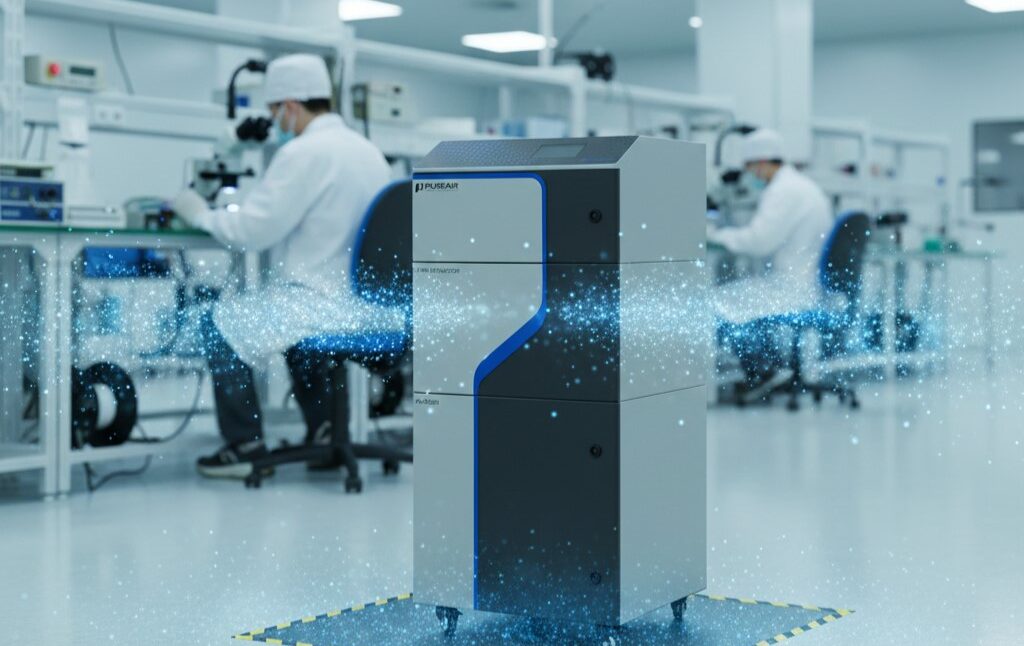
An anti-static air purifier works by stripping the “power” away from these rebellious particles. It transforms the filtration process from a chaotic electrical struggle into a controlled physical capture.
Conductive Pathing and Grounding
The first line of defense is the physical structure of the purifier. By using conductive materials for the intake hoods, flexible hoses, and the main housing, the system creates a continuous path to the ground.
-
Dissipating the Charge: As soon as a charged particle touches a conductive component of the anti-static system, its excess electrons are bled off to the earth.
-
Preventing Arcing: In industries involving flammable metallic dust (like aluminum or titanium), neutralizing static is also a critical fire-safety measure, preventing the sparks that lead to dust explosions.
3. Advanced Filter Media: The Core of Persistent Capture
The “heart” of an anti-static system is the filter itself. In a standard purifier, a filter is just a mesh. In an anti-static model, the filter is a precision-engineered “capture zone.”
Anti-Static Membrane Technology
Professional-grade systems utilize filter cartridges coated with conductive aluminum or carbon-infused membranes.
-
Physical Entrapment: Once the static charge is neutralized, the particle loses its “stickiness” to walls and its “repulsion” to fibers. It is now subject purely to the laws of physical impingement and Brownian motion.
-
Easy Dust Release: Static is often the reason filters become permanently clogged (blinded). By eliminating the electrostatic bond between the dust and the filter, the “pulse-jet” cleaning system can easily shake the dust off into the collection bin, maintaining a low pressure drop and high airflow.
4. The Health Imperative: Capturing the “Un-filterable.”
Sub-micron particles, particularly metallic fumes from welding or soldering, are “respirable.” This means they are small enough to bypass the human body’s natural defenses (nose hair and mucus) and penetrate deep into the alveoli of the lungs, entering the bloodstream.
-
Deep Purification: Standard purifiers might capture the “big” dust you can see, but they often fail at the sub-micron level where the static is strongest.
-
Zero-Escape Architecture: First, the anti-static air purifier guides even the finest metallic smoke directly into the filter. As a result, it neutralizes static adhesion and permanently removes high-risk airborne toxins.
5. Efficiency and Longevity
Beyond safety, anti-static technology is a massive driver of industrial efficiency.
-
Reduced Maintenance: When dust doesn’t stick to the inside of your ducts or the “clean side” of your machine, you spend significantly less time on deep-cleaning and maintenance.
-
Longer Filter Life: Filters that aren’t “blinded” by electrostatic adhesion last up to 2-3 times longer than those in standard systems.
-
Energy Savings: A clean, non-clogged filter allows the motor to run at lower RPMs while maintaining the same suction power, directly reducing the factory’s electricity bill.
6. Conclusion: A Firewall for Your Air
In the battle against industrial pollution, we must fight at the level of physics. We cannot allow the “adhesion rebellion” of static-charged particles to compromise the health of workers or the precision of equipment.
An anti-static air purifier is more than just a vacuum; it is a sophisticated “electrical firewall.” Neutralizing charges at the source, it prevents static buildup. Moreover, it provides a grounded path for microscopic debris. As a result, the filter captures sub-micron threats effectively. Thus, particles remain contained instead of escaping electrical flaws. In the pursuit of a zero-emission workspace, anti-static technology is the final, essential bridge between “filtering” and “truly purifying.”