How to Choose the Right Fume Extractor for Industrial Applications:a Professional Guide to Airflow, Filtration, Negative Pressure and Operating Costs
Industrial manufacturing processes such as laser cutting, welding, soldering, grinding, engraving, and metal processing can generate smoke, fine dust, metal particles, VOCs, and other airborne contaminants. Without effective extraction and filtration, these pollutants may affect workplace air quality, employee comfort, equipment performance, and production efficiency.
However, choosing the right fume extractor is not simply about selecting a machine with the highest airflow or the lowest price. A professional fume extraction system needs to be matched to the specific application, contaminant characteristics, production volume, filtration requirements, and workshop layout. This article explains the key factors manufacturers should consider before investing in an industrial fume extractor.
1. Understand Your Application and Fume Characteristics
The first step in selecting the right fume extractor machine is to understand exactly what your production process generates. Different industrial applications produce different types and concentrations of contaminants, so the extraction and filtration system must be designed accordingly.
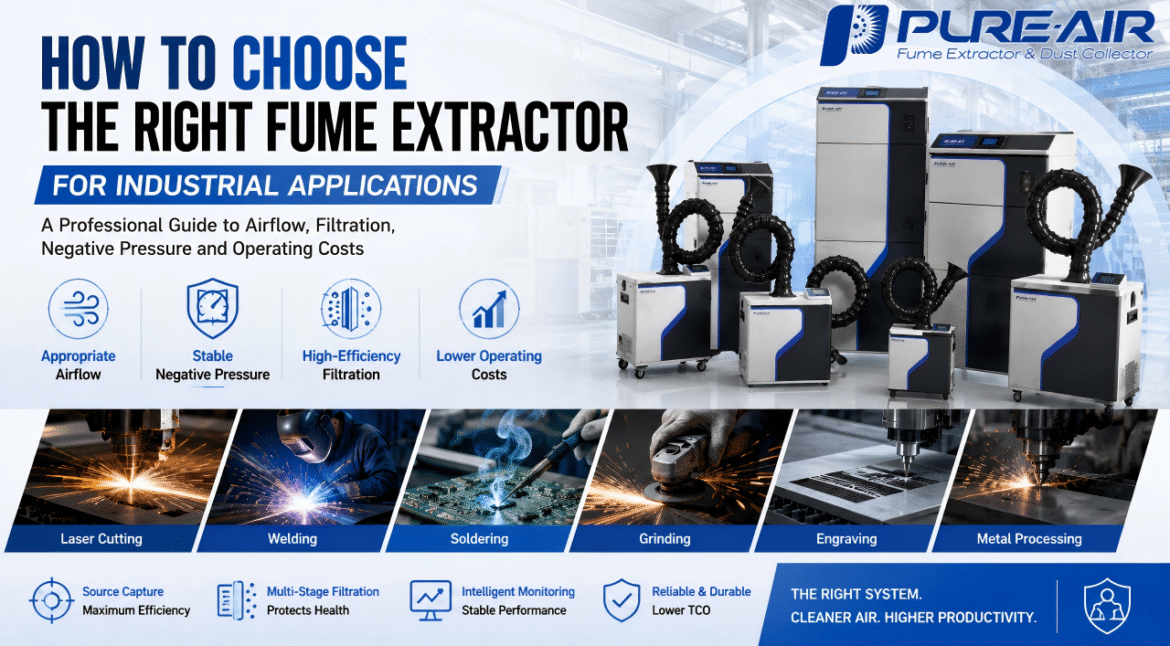
For example, laser cutting and laser marking can generate fine particulate matter, metal oxide particles, smoke, VOCs, and odors, depending on the material being processed. Welding produces fine metal fumes and particles, while soldering may generate flux and rosin-based fumes. Grinding and other metal processing operations can produce both larger particles and fine dust.
This means there is no universal fume extractor that is automatically suitable for every application. The system should be selected according to the material, process, contaminant type, production intensity, and capture method.
Source capture is particularly important. Fumes should be collected as close to the generation point as possible, before they disperse throughout the workshop. Once contaminants spread into the surrounding air, they become much more difficult to control. Therefore, the extraction hood, extraction arm, airflow direction, negative pressure, and equipment layout should all be considered as part of the overall fume extraction system.
2. Evaluate Airflow, Negative Pressure and Filtration
Airflow is one of the most commonly considered specifications when purchasing an industrial fume extractor, but higher airflow does not always mean better performance. If airflow is too low, contaminants may not be captured effectively. If it is unnecessarily high, the system may consume more energy, create excessive noise, and increase filter loading and operating costs.
A professional system should provide the appropriate airflow based on the application, capture distance, duct resistance, contaminant generation rate, and workstation design.
At the same time, negative pressure is critical because the extraction system must overcome resistance created by hoses, ducts, filters, bends, extraction hoods, and filter loading. PURE-AIR uses a self-developed high negative pressure fan to provide powerful and stable suction for demanding industrial applications.
Filtration is another essential consideration. Different contaminants require different filtration strategies. A professional industrial air filtration system may combine pre-filtration, fine filtration, HEPA filtration, and activated carbon adsorption. Pre-filters capture larger particles and protect downstream filters, while high-efficiency filters remove fine particulate matter. Activated carbon can be used when VOCs or odors require additional adsorption treatment.
The correct filtration configuration should always be based on the actual contaminants generated by the production process rather than simply selecting the maximum number of filters.
3. Consider Filter Life, Intelligent Control and Total Operating Costs
The initial fume extractor price is only one part of the total investment. Manufacturers should also consider filter replacement costs, energy consumption, maintenance requirements, downtime, and expected service life.
As filters accumulate dust and fumes, their resistance gradually increases. If the extraction system cannot compensate for this change, airflow may decrease and source-capture performance can deteriorate. This is why filter capacity and system control are important factors when selecting an industrial fume extractor.
PURE-AIR integrates large-capacity long-life filters with the PIPS Intelligent Purification System to help maintain stable system performance. PIPS can monitor important operating conditions such as airflow, negative pressure, and filter status. Intelligent airflow compensation helps respond to changes in filter resistance, while filter monitoring and system alerts make maintenance more predictable.
When comparing different machines, manufacturers should therefore look beyond the purchase price and consider the Total Cost of Ownership (TCO):
Purchase Cost + Energy Cost + Filter Replacement Cost + Maintenance Cost + Downtime Cost
A machine with a lower initial price may not necessarily be the most economical choice in the long term. A reliable system with efficient filtration, longer filter life, stable performance, and intelligent monitoring can provide better overall value throughout its service life.
4. Choose the Right System for Your Production Scale
The final consideration is whether you need a portable fume extractor, a fixed system, or a centralized fume extraction solution.
Portable systems are suitable for individual workstations and applications that require flexibility, such as welding, laser marking, repair operations, or production areas where equipment needs to be moved. A centralized system may be more suitable for larger factories with multiple laser cutting machines, welding stations, or other production processes operating simultaneously.
Before selecting a system, manufacturers should consider the number of workstations, required airflow, operating hours, workshop layout, ducting requirements, and future production expansion.
A professional supplier should evaluate these factors together rather than simply recommending a standard machine based on airflow or price. The objective is to create a balanced system that provides effective source capture, reliable filtration, stable operation, and reasonable long-term operating costs.
Conclusion
Choosing the right fume extractor is an important decision for manufacturers looking to improve workplace air quality and maintain reliable production. The best solution should be selected based on the type of fumes, source-capture requirements, airflow, negative pressure, filtration configuration, filter life, intelligent control, maintenance requirements, and total cost of ownership.
With more than 15 years of manufacturing experience, PURE-AIR combines its self-developed High Negative Pressure Fan, PIPS Intelligent Purification System, and Large-Capacity Long-Life Filters to provide professional industrial fume extraction solutions for laser processing, welding, soldering, metal fabrication, and other manufacturing applications.
If you are struggling with poor extraction performance, unstable airflow, frequent filter replacement, or high maintenance costs from your current fume extractor, contact our team. PURE-AIR can evaluate your application and help you find a more efficient and reliable fume extraction solution.