In the high-stakes theater of microelectronics, semiconductor packaging, and precision sensor assembly, the margins for error have migrated from the visible to the sub-atomic. As components shrink to the micron level, the hazards they face have become equally invisible. Among these, Electrostatic Discharge (ESD) stands as a silent destroyer—an atmospheric phantom capable of vaporizing delicate circuits in a fraction of a microsecond.
For years, the industry focused on air purity alone. However, traditional dust and fume collection systems often became accidental contributors to the problem, generating thousands of volts of static through air friction in non-conductive ducts. The emergence of anti-static fume extractor units has fundamentally rewritten this script. By creating a “Static Safety Zone,” these systems do more than just clean the air; they safeguard million-dollar production yields and months of R&D, ensuring that every weld is an “Absolute Operation.”
1. The Invisible Destroyer: Why Standard Extraction is a Risk
To understand the necessity of an anti-static system, one must understand the physics of the “Triboelectric Effect.” In a standard fume extractor, as smoke particles and air move at high velocities through plastic hoses and synthetic filters, electrons are stripped and reassigned. This friction can generate static charges exceeding 5,000V.
The Vulnerability of the Micron World
Modern Integrated Circuits (ICs) often feature gate oxides that are only a few molecules thick.
-
Instantaneous Rupture: A discharge as low as 100V—completely imperceptible to a human—is enough to punch a hole through a transistor gate, leading to immediate “catastrophic failure.”
-
Latent Defects (The “Walking Wounded”): Perhaps more dangerous is the “Latent Failure.” A minor ESD event might weaken a circuit without killing it. The device passes final inspection but fails weeks later in the hands of the customer, devastating brand reputation and increasing warranty costs.
2. The Architecture of the “Static Safety Zone.”
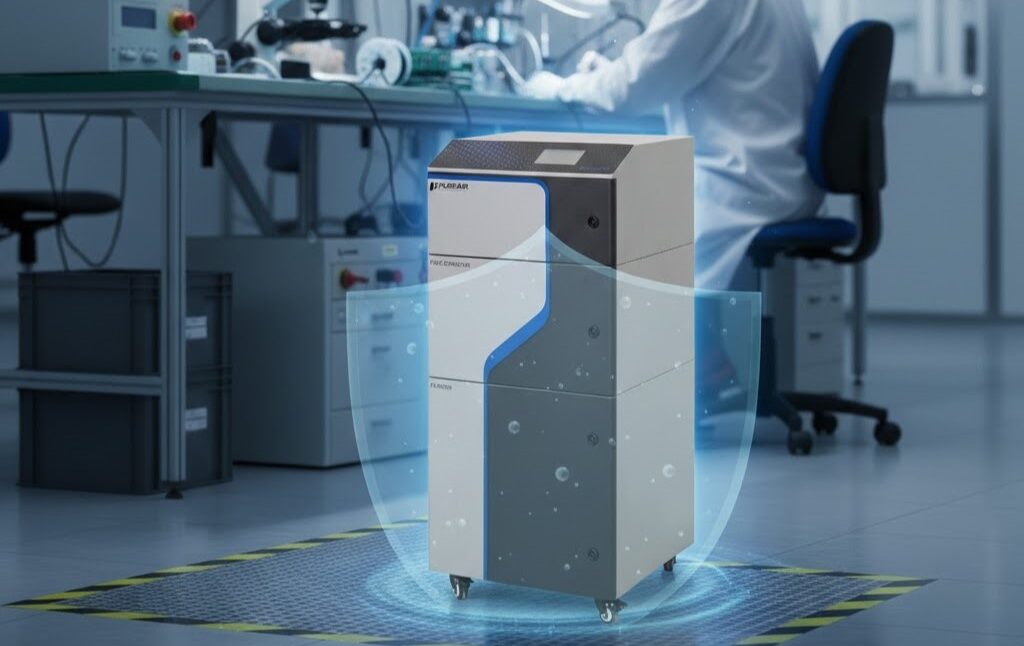
An anti-static fume extractor unit is not merely a standard machine with a label. It is a ground-up engineering solution designed to maintain an equipotential environment.
Conductive and Dissipative Materials
The first line of defense is the physical path the fume takes.
-
ESD-Safe Suction Arms: Unlike standard plastic arms, these are constructed from carbon-loaded polymers or specialized conductive alloys. This ensures that any charge generated by air friction is immediately bled off to the ground rather than accumulating on the surface.
-
The Metal-to-Metal Grounding Chain: From the suction hood to the filter housing and finally to the power cord, every component is linked in a continuous, low-resistance electrical path.
Ionization and Neutralization
High-end units often incorporate active ionizers within the airflow path. By injecting both positive and negative ions into the stream, the unit “neutralizes” the air. This prevents the “clumping” of particles due to static attraction, which improves filtration efficiency while ensuring the air returned to the cleanroom is electrically neutral.
3. Advanced Filtration: The Science of “Zero Leakage.”
In precision electronics, “clean” is a relative term. The goal of an anti-static fume extractor unit is to achieve a state of “Zero Impact” on the delicate soldering environment.
HEPA and ULPA Standards
Solder fumes contain microscopic lead-free particles, flux vapors, and VOCs (Volatile Organic Compounds) that are often sub-micron in size.
-
Sub-Micron Capture: Using H13 or H14 HEPA filters, these units capture 99.97% to 99.99% of particles down to 0.3µm.
-
Anti-Static Filter Media: Standard glass fiber filters can become static-charged. ESD-safe units utilize filters with integrated conductive fibers to ensure the “filter cake” itself does not become a high-voltage plate.
Chemical Absorption
Soldering fluxes (especially No-Clean and Rosin-based) release corrosive gases that can settle on high-value PCBs. Integrated activated carbon stages absorb these gases, preventing them from reacting with the sensitive gold or copper traces on the board.
4. The Economics of Yield: Pressing “Pause” on Losses
The implementation of anti-static fume extractor units are often viewed through the lens of compliance, but its true value is found in the “Economics of Yield.”
-
Protecting the “Golden Hour”: In semiconductor packaging, the “Golden Hour” is the time between cleaning and sealing. Any contamination or ESD event during this window results in a total loss of the batch. A static-safe extractor allows the process to pause and proceed with total environmental confidence.
-
Reduction in Scrap Rates: In facilities manufacturing high-density interconnect (HDI) boards, switching to ESD-safe extraction can reduce “unexplained” failure rates by as much as 15–20%.
-
Employee Health & Precision: By removing toxic fumes without the noise and vibration of massive central systems, these localized units allow technicians to maintain the steady hands required for micro-soldering, indirectly improving the mechanical quality of the work.
5. Integration into the Smart Factory
The anti-static fume extractor unit is increasingly becoming intelligent nodes in the manufacturing ecosystem.
-
Constant Monitoring: Integrated sensors monitor the resistance to ground in real-time. If the grounding path is compromised, the unit can trigger an alarm or even signal the soldering station to shut down, preventing “Unprotected Operation.”
-
Variable Frequency Drives (VFD): The unit adjusts its suction power based on the number of active stations, ensuring optimal airflow without excessive turbulence, which is itself a generator of static.
6. Conclusion: A Commitment to the Absolute
In the micro-world, there is no such thing as a “minor” error. Every volt and every particle matters. The anti-static fume extractor units represent the final evolution of industrial air management—a shift from “Cleaning” to “Safeguarding.”
By neutralizing invisible ESD threats, these units protect sensitive electronics. Meanwhile, they capture microscopic welding fumes, creating a secure production environment. As a result, manufacturers can mitigate physical risks during critical processes. Thus, only the designer’s intent reaches the silicon surface. Ultimately, investing in ESD-safe extraction ensures absolute operational reliability.