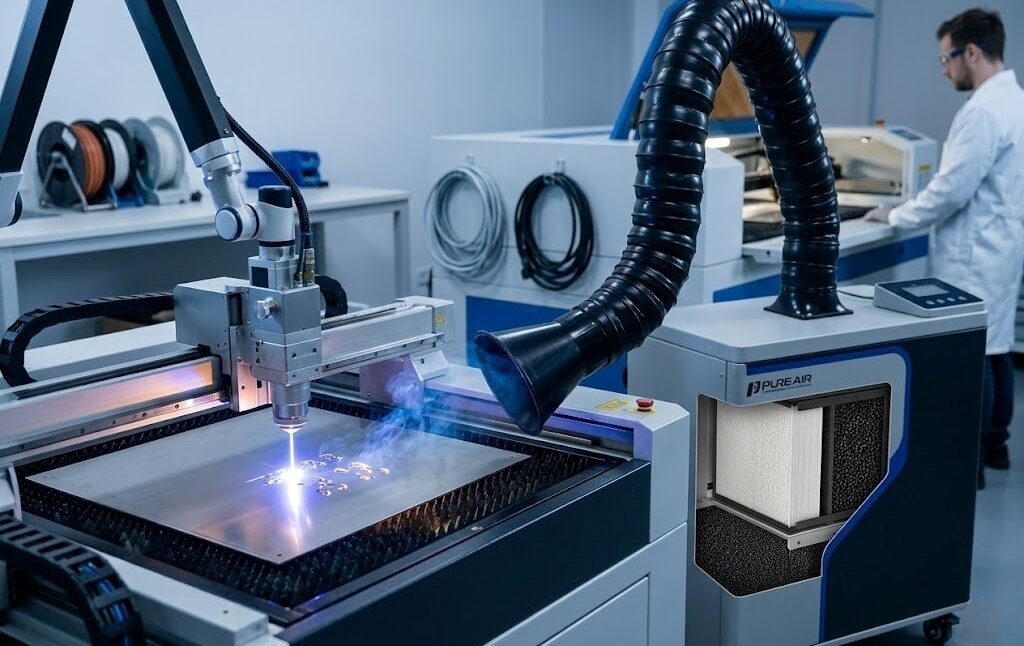
Imagine the sharp smell of burning acrylic. Or the thick, gray haze from laser-cut wood. These are not just smells. They are invisible chemical cocktails. You need more than just a fan. You need a professional laser smoke purifier. But which filter truly keeps you safe? This guide explores the “inner peace” of high-end filtration. We help you choose the right shield for your workshop.
1. The HEPA Duel: Is H14 Always Better Than H13?
HEPA filters are the “physical lungs” of your laser smoke purifier. They trap tiny, dangerous particles. However, not all HEPA filters are equal.
The 99.97% Standard: HEPA H13
H13 is the medical-grade workhorse. It captures 99.97% of particles as small as 0.3 microns. Consequently, it stops most wood dust and metallic soot. For standard engraving, H13 offers excellent protection.
The Ultra-Pure Shield: HEPA H14
H14 elevates your safety to 99.995%. This means it lets almost nothing pass through. Therefore, it is ideal for high-precision electronics or cleanrooms. We match the filter density to your specific laser workload. Thus, you get the perfect balance of airflow and purity.
2. Activated Carbon: The Master of Invisible Threats
While HEPA stops dust, it ignores toxic gases. This is where activated carbon saves the day. It acts as a “chemical sponge” for your laser smoke purifier.
Standard Carbon vs. Impregnated Carbon
Normal carbon absorbs basic odors effectively. However, laser cutting creates aggressive VOCs (Volatile Organic Compounds). Therefore, we often use impregnated carbon. We chemically treat the charcoal to neutralize specific toxins. For example, it can target formaldehyde or acidic gases. This “smart” carbon doesn’t just hold the gas. It breaks it down chemically. Consequently, your workspace stays truly fresh and safe.
3. Material vs. Menace: What Are You Actually Cutting?
Different materials create different “invisible enemies.” Your laser smoke purifier must be ready for all of them.
-
Wood & Paper: These create thick, sticky smoke. You need a strong HEPA H13 to prevent clogging.
-
Acrylic (PMMA): This produces a pungent, sweet smell. It releases massive amounts of VOCs. Therefore, a heavy-duty carbon bed is mandatory.
-
Leather: Cutting leather releases unpleasant sulfur compounds. It requires specialized impregnated carbon for odor control.
-
Metals: Laser marking on metal creates fine, toxic metallic dust. In this case, H14 filtration provides the best long-term safety.
4. Data Doesn’t Lie: Third-Party Performance
We believe in transparency, not just empty claims. Every laser smoke purifier from PURE-AIR undergoes rigorous testing.
We provide third-party reports for every machine. These reports show impressive CADR (Clean Air Delivery Rate) values. Moreover, our TVOC removal rates often exceed 98%. We track formaldehyde and benzene levels carefully. Consequently, you can show these data sheets to safety inspectors. You prove that your facility meets international health standards. We turn “feeling safe” into “being safe” with hard numbers.
Conclusion: Choose the Right Shield for Your Craft
Filtering laser smoke is a serious science. It requires the right mix of physics and chemistry. Do not settle for a basic fan. Protect your team with a professional laser smoke purifier.
Let the HEPA H14 trap the dust. Let the impregnated carbon eat the toxins. Together, they create a healthy, productive environment. At PURE-AIR, we are ready to help you choose. We bring clean air to every laser studio. Experience the difference of industrial-grade filtration today. Your lungs will thank you for every breath.