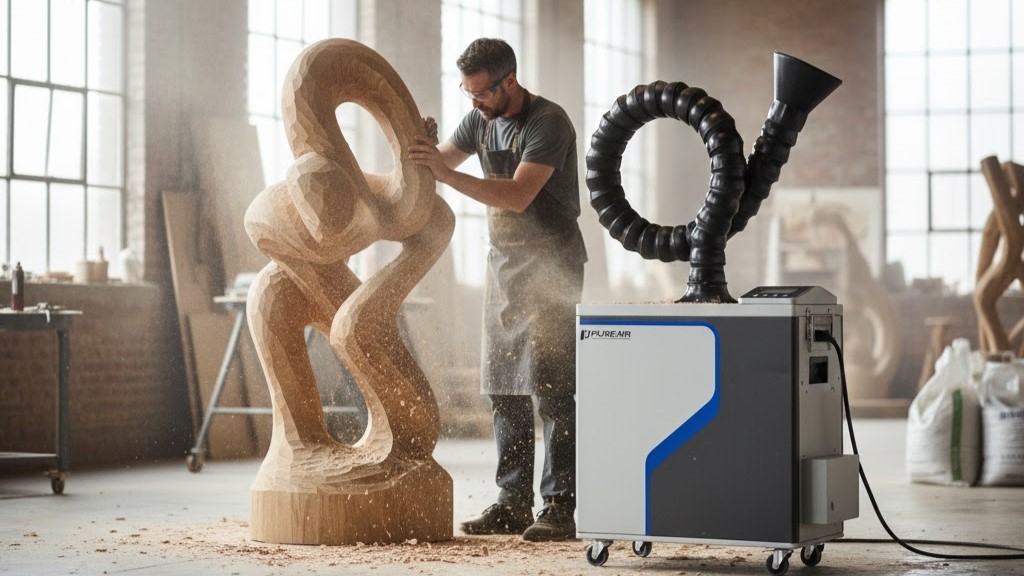
In vast, high-ceilinged workshops, monumental projects take shape. Here, a silent battle unfolds, driving creativity and precision. Public monuments, theatrical backdrops, and avant-garde installations emerge through relentless effort. It is the struggle between the boundless imagination of the creator and the physical reality of the medium. Whether carving stone, grinding steel, or sanding fiberglass, the byproduct is always the same: a dense, hazardous cloud of particulate matter.
In these dynamic environments, a fixed, centralized ventilation system often fails. Large-scale art projects are nomadic by nature; a sculpture might occupy the center of the floor today and a specialized spray booth tomorrow. This is where mobile dust collection systems step in. Functioning as a flexible, reliable “second set of hands,” these portable units follow the project’s progress, providing immediate protection during welding, grinding, and finishing. This article explores how modular air purification technology liberates artists from the constraints of dust, allowing creativity to breathe freely.
1. The Dynamic Studio: Why Fixed Ventilation Fails the Artist
In a traditional factory setting, machines are bolted to the floor, allowing for permanent ductwork. However, a large-scale art studio is a living, breathing ecosystem.
The Challenge of Scale and Movement
A ten-meter-tall bronze sculpture cannot be moved to a small “sanding station.” Instead, the artist must move around the sculpture.
-
The Geographic Gap: If the dust extraction point is fixed to a wall, the artist quickly loses protection as they move to the opposite side of the piece.
-
Multi-Process Conflict: An artist may spend the morning TIG welding and the afternoon angle-grinding. These processes produce different types of pollutants—one a toxic gas, the other a heavy combustible dust. A static system rarely handles this versatility efficiently.
The Mobile Solution
Mobile dust collection systems are designed for this exact fluidity. Equipped with heavy-duty casters and flexible extraction arms, they allow the “protection zone” to travel with the artist. Whether working on a scaffold or tucked inside a hollow metal casting, the artist can position the suction hood exactly where the sparks fly.
2. Versatility in Craft: One System, Multiple Masterpieces
The beauty of a high-quality mobile collector lies in its “chameleonic” ability to adapt to different artistic media.
Metalwork: Taming the Fumes and Sparks
Welding and plasma cutting are staples of modern sculpture. These processes release sub-micron metal oxides that are easily inhaled.
-
The “Second Hand” Role: The flexible arm of a portable extractor acts like an assistant holding a vacuum. It captures hot fumes at the source before they can rise into the artist’s breathing zone, while spark-arresting pre-filters ensure the system remains safe during high-heat operations.
Wood and Stone: Managing Massive Volume
When carving large-scale timber or marble, the volume of dust is immense.
-
High-Capacity Filtration: Professional mobile dust collection systems utilize HEPA or PTFE-coated cartridge filters that can handle heavy loading. They prevent the “white fog” of stone dust from settling on every surface of the studio, protecting sensitive electronics and finished works located elsewhere in the shop.
Composite Materials and Resins
For theater sets and modern pop-art installations, fiberglass and resin are common. Sanding these materials creates a fine, “itchy” dust that is both a health hazard and a fire risk. The mobile unit’s high static pressure effectively captures even the smallest particles. It pulls the most stubborn particles directly into the filtration chamber.
3. The Anatomy of an Invisible Assistant: Technical Features
To truly support an artist, a mobile dust collector must be more than just a vacuum; it must be a piece of precision engineering.
-
360-Degree Flexible Suction Arms: These arms must be “self-supporting,” meaning they stay in the exact position the artist places them. This allows the artist to focus both hands on their tool while the “second hand” manages the air.
-
Multi-Stage Filtration: From a primary metal mesh (for sparks) to a secondary bag filter (for large debris) and a final HEPA filter (for 99.97% of fine particles), the system ensures that the air exhausted back into the studio is cleaner than the ambient air.
-
Low Noise Signature: Art requires focus. A loud, industrial drone can be fatiguing. Modern mobile units are sound-dampened to operate at decibel levels that allow for conversation or music to be heard in the background.
4. Safety as a Creative Catalyst: The Psychological Impact
When a workshop is clean, the creative process accelerates. Dust is not just a physical nuisance; it is a mental burden.
-
Eliminating Post-Work Cleanup: Large-scale projects can take months. If dust is allowed to settle, the final cleanup can take weeks. By capturing dust at the source, mobile dust collection systems keep the studio in a state of “permanent readiness.”
-
Artist Longevity: Respiratory issues are the leading professional hazard for long-term sculptors. Providing a clean environment ensures that the artist can continue their craft for decades, preserving their health as carefully as they preserve their art.
-
Compliance Without Complexity: For public art institutions and universities, safety regulations are strict. Mobile collectors offer an “out-of-the-box” solution that meets OSHA or local health standards without the need for expensive structural renovations.
5. From Theaters to Plazas: Diverse Application Scenarios
The portability of these systems allows them to move beyond the traditional studio:
-
Theatre Scenery Shops: Where massive wooden structures are built and painted in rapid succession.
-
On-Site Restoration: When a public monument needs cleaning or repair in a city plaza, a mobile collector can be brought to the site to prevent dust from affecting the public.
-
Prototyping Labs: Where 3D printing and manual finishing happen side-by-side.
6. Conclusion: Letting Creativity Breathe
In the world of monumental art, every detail matters—but the most important detail is the air the artist breathes. Mobile dust collection systems have moved from being an “industrial accessory” to becoming an essential part of the artistic process.
By acting as a flexible, powerful, and silent “second set of hands,” these systems allow the creator to tackle the toughest materials and the most massive scales without fear. When the dust is managed, the artist is no longer a “cleaner”—they are a creator. It is time to let your studio move as fast as your ideas, and let the mobile collector handle the rest.