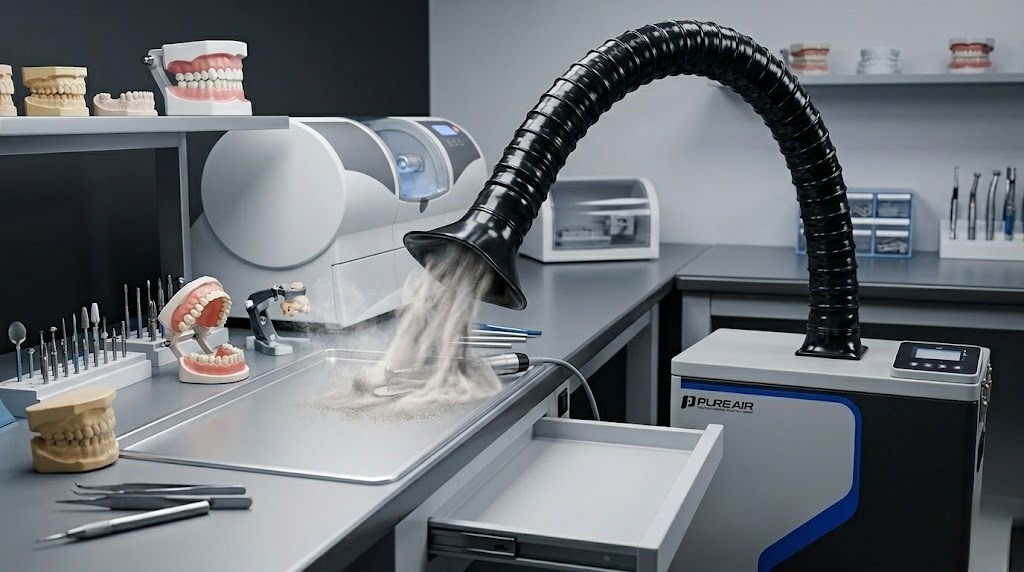
Protecting air quality in a dental laboratory is a major health priority. Milling zirconia and ceramics creates fine, dangerous dust particles. Consequently, choosing the right filtration system is critical for your staff. Most high-performance systems rely on HEPA standards to capture these tiny pollutants. However, many owners struggle to choose between H13 and H14 ratings. This guide explores the best balance for a silent dental milling dust collector. We help you optimize safety without wasting your budget.
1. Understanding the HEPA Hierarchy
HEPA filters capture particles that standard vacuum bags miss completely.
The Efficiency of H13 Filters
The H13 grade is the standard for high-end medical environments. Consequently, it captures 99.95% of particles as small as 0.1 microns. This includes the majority of fine zirconia and porcelain dust. Furthermore, it allows for high airflow while maintaining a very quiet operation. Therefore, it is the primary choice for a silent dental milling dust collector.
The Extremes of H14 Filters
H14 filters offer an even higher efficiency of 99.995%. Consequently, they are often required in semiconductor factories or surgical theaters. However, this dense mesh creates significantly higher air resistance. Furthermore, you need a much stronger motor to pull air through it. Therefore, H14 systems often consume more energy and create more noise.
2. Why H13 is the “Sweet Spot” for Dental Labs
Investing in a higher grade does not always lead to better results.
Capturing Zirconia Dust Effectively
Zirconia dust particles typically range from 0.1 to 10 microns in size. Consequently, the H13 filter traps these particles with nearly perfect efficiency. There is no measurable health benefit to upgrading to H14 for dental work. Furthermore, H13 filters are much more affordable to replace during routine maintenance. Therefore, you save money while keeping your air perfectly clean.
Reducing Noise and Increasing Suction
A silent dental milling dust collector depends on efficient airflow management. Consequently, the lower resistance of H13 helps keep the motor noise down. You get powerful suction without the roar of a strained engine. Furthermore, your CAD/CAM milling machine will run cleaner and last longer. Therefore, H13 provides the best balance of performance and comfort.
3. Key Features of a Professional Extraction System
Beyond the filter grade, other technical factors ensure a healthy workspace.
-
Brushless Motors: These provide longer life and much quieter operation levels.
-
Multi-Stage Filtration: Use a pre-filter to catch large chips before the HEPA.
-
Automatic Sync: The collector should start and stop with your milling machine.
Consequently, you create a seamless and healthy workflow in your laboratory. Furthermore, regular filter monitoring ensures you never lose suction power unexpectedly. Therefore, a well-maintained H13 system provides years of reliable service.
Conclusion: Smarter Air for Healthier Labs
Create a cleaner, more efficient workspace that keeps pace with your laboratory’s high-speed production demands. Instead of overspending on H14 filters that often increase both noise levels and energy consumption, it makes far more sense to adopt the balanced performance of H13 filtration technology for dental milling applications.
By making this switch, you actively improve airflow efficiency while maintaining reliable dust capture. As a result, your silent dental milling dust collector operates more smoothly, consumes less energy, and delivers consistent performance throughout extended use. Moreover, H13 filters provide an optimal combination of filtration precision and operational efficiency, making them a practical choice for modern labs.
Now is the time to upgrade your air filtration strategy. With professional-grade solutions in place, you not only protect your staff from airborne particles but also extend the lifespan of your equipment. Ultimately, a cleaner environment leads to better productivity, improved comfort, and long-term cost savings.
Look at our Facebook: https://www.facebook.com/pureairen