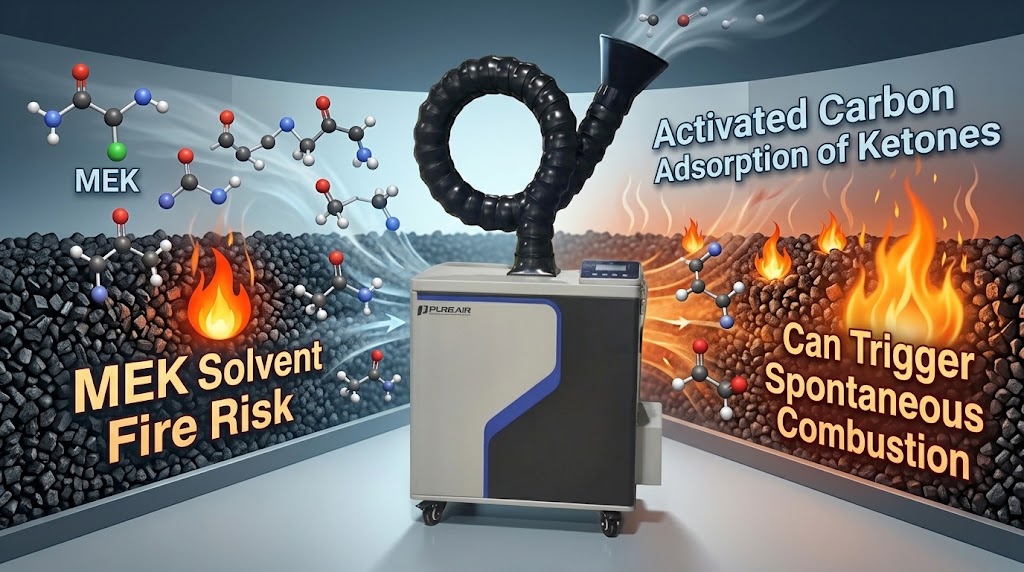
MEK (Methyl Ethyl Ketone / Butanone) is widely used in printing, packaging, and coating industries. It supports ink formulation, printhead cleaning, and fast-drying solvent applications. However, MEK vapor control creates a major safety challenge for many facilities. Standard activated carbon filters may face thermal risks during MEK adsorption.
Many print shop managers and safety engineers ask a critical question:
“Can standard activated carbon safely capture MEK fumes, or can it cause fire risks?”
To answer this question, facilities must understand ketone adsorption behavior. MEK interacts with virgin activated carbon through exothermic adsorption reactions.
Poor airflow, high vapor concentration, and heat accumulation can increase thermal runaway risks.
Understanding these adsorption mechanisms helps manufacturers prevent filter fires. It also supports safer solvent handling and compliant production environments.
Thermal Hazards of Ketone Adsorption: Heat Generation and Self-Ignition
Activated carbon efficiently captures volatile organic compounds (VOCs) through high surface area adsorption. However, standard activated carbon faces thermal risks with ketone solvents.
MEK and acetone vapors can generate adsorption heat inside carbon beds. These solvent molecules release heat when they attach to carbon surfaces. Some ketone compounds can also trigger oxidation reactions within carbon media. These reactions increase internal heat generation during filtration.
Low airflow conditions can trap heat inside the activated carbon bed. High solvent concentrations can further increase thermal accumulation risks. Poor heat dissipation allows temperatures to rise continuously. Rising temperatures can accelerate oxidation reactions inside the filter. This process may create a thermal runaway cycle. Eventually, the carbon bed may face self-ignition risks.
Facilities should select solvent-resistant carbon formulations for VOC control. Operators should maintain proper airflow throughout the filtration system. Engineers should install thermal monitoring for reactive solvent applications. These measures improve filtration safety and ensure reliable VOC removal performance.
1. High Heat of Adsorption
Adsorption is fundamentally an exothermic process. As gaseous MEK molecules condense into the microscopic pores of activated carbon, latent heat is released. Ketone molecules release a higher heat of adsorption compared to simple alkanes or alcohols.
2. Catalytic Oxidation and Hot Spot Formation
Virgin activated carbon often contains trace metallic impurities or ash content that acts as a catalyst. When MEK is trapped within carbon pores in the presence of oxygen, a catalytic oxidation reaction can occur, converting ketones into organic acids and aldehydes. This reaction continuously generates heat.
If air movement pauses or oxygen flow drops while solvent concentrations remain high, heat accumulates rapidly inside the carbon bed. Once temperatures surpass the auto-ignition threshold of the adsorbed bed, spontaneous combustion and bed fires occur.
Engineering Safeguards: Preventing Heat Accumulation in Printing Fume Extraction
To safely handle aggressive solvent vapors like MEK, industrial fume extraction systems must combine specialized media bed engineering with continuous negative-pressure airflow.
           [ Industrial Inkjet / UV / MEK Solvent Vapor Input ]
                                     │
  ┌──────────────────────────────────┼───────┐
  │                                  │                                  │
[ High-Velocity Extraction ]  [ Multi-Stage VOC Filtration ]  [ PIPS Intelligent Control ]
Continuous negative pressure  Molecular sieve carbon beds      Prevents thermal accumulation
prevents vapor stagnation     engineered for ketone safety     and maintains system health
1. Specialized Carbon Formulations & Molecular Sieve Layers
To mitigate ketone-related fire risks, VOC fume extraction utilizes specially treated, low-ash, or chemically impregnated carbon beds alongside molecular sieve carbon structures. These optimized media formulations inhibit catalytic oxidation, allowing ketone vapors to be safely adsorbed without localized hot-spot formation.
2. Continuous Air Movement & Thermal Dissipation
Maintaining consistent high-velocity airflow through the filter chamber dissipates the heat of adsorption as it forms. Industrial extractors engineered with high negative pressure prevent solvent vapor stagnation, ensuring that thermal energy is continuously carried away from the filtration media.
Multi-Stage VOC Purification for Printing Environments
Printing operations involving solvent-based inks, inkjet coding, and UV curing release a complex mixture of emissions beyond MEK—including ozone, fine ink mist, and photoinitiator off-gassing.
      PRINTING FUME PURIFICATION STAGES

  [ High-Concentration Ink Mist & VOCs ]
                   │
  ├── Stage 1: Pre-Filter (Captures airborne ink mist & particulates)
  ├── Stage 2: HEPA Filter (Traps sub-micron fine particles)
  └── Stage 3: PIPS VOC Carbon Module (Safely adsorbs MEK & solvent vapors)
Integrating multi-stage purification ensures that particulate ink overspray is captured before reaching the chemical adsorption bed, preserving the open pore volume of the carbon media and maintaining optimal airflow.
Summary and Safety Recommendations for Solvent Printing
Standard activated carbon filters can create fire risks when they capture MEK solvent vapors. MEK adsorption releases heat through exothermic reactions inside carbon media. High solvent concentrations can increase temperatures and trigger catalytic oxidation. Printing facilities must select specialized carbon filters for ketone-based VOC applications. Advanced VOC fume extraction uses optimized carbon media to improve solvent capture safety.
Multi-stage filtration systems remove VOCs while reducing thermal runaway risks. High negative pressure extraction captures MEK vapors directly at the source. Proper filtration design helps printing facilities control VOC emissions and protect operators.
Advanced Printing Fume Extraction Solutions from PURE-AIR
At PURE-AIR, we specialize in designing and manufacturing high-efficiency industrial fume extractors engineered specifically for demanding printing, inkjet, and UV curing applications.
-
PURE-AIR FS-i Series Fume Extraction Unit: Purpose-built for industrial inkjet, digital printing, and UV curing systems releasing high concentrations of VOCs, MEK vapors, ozone, and fine ink mist.
-
PIPS Purification Technology: Utilizes advanced multi-stage purification to achieve up to 99.99% filtration efficiency, safely handling complex chemical emissions while meeting OSHA and environmental compliance standards.
-
Compact Structure with Ultra-High Pressure: Features a space-saving design that reduces footprint requirements by up to 40%, delivering powerful negative pressure to maintain continuous airflow and prevent heat stagnation.
-
Intelligent Operational Safety: Engineered for long-term reliability in high-volume production lines, professional printing facilities, and industrial workshops.
Protect your operators, equipment, and facility from solvent hazards. Contact the engineering team at PURE-AIR today to select the ideal FS-i Series VOC fume extraction for your printing operation!