In the world of advanced surface engineering, laser cladding has become a foundational technology for repairing high-value components, extending operational lifecycles, and applying wear-resistant coatings. By utilizing a high-power laser beam to melt and fuse specialized metallic powders onto a substrate, manufacturers achieve unparalleled metallurgical bonding.
However, when processing superalloys—specifically nickel-based alloys like Inconel 625 or Inconel 718—the administrative headache shifts from the laser optics to the workshop floor.
Many facilities assume that a standard shop-floor dust collector or an off-the-shelf industrial vacuum can handle the overspray. In practice, they discover that their extraction systems clog within hours, airflow drops to zero, and the workspace fills with toxic haze. This guide breaks down the physics of why nickel-based alloy dust is uniquely “sticky” and outlines how advanced laser cladding fume purification keeps high-precision automated manufacturing lines running without interruption.
1. The Science of Adhesion: Why Nickel Superalloy Dust is “Sticky.”
To understand why traditional extraction systems fail, we must look at the physical and chemical state of the overspray powder generated during the cladding process. Unlike standard dry wood dust or cold aluminum shavings, laser cladding particulates undergo severe thermodynamic transformations.
 Laser Beam Melting ──> High Surface Energy + Triboelectric Static ──> Molecular Agglomeration
                                                                             │
                                                                   (Bonds Tight to Standard Polyester)
Three overlapping factors combine to give nickel-based superalloy particulates their aggressive, glue-like adhesion properties:
High Surface Energy and Unsaturated Chemical Bonds
As the laser vaporizes and atomizes the nickel alloy powder feed, microscopic droplets freeze mid-air into ultrafine particulates (often ranging from 0.1 to 5 microns). Because these spheres form rapidly, their outer atomic layers possess high surface energy and unsatisfied molecular bonds. Seeking stability, these particles instantly attach themselves to any physical surface they contact—especially the synthetic fibers of a standard vacuum filter.
Triboelectric Static Accumulation
During high-velocity gas atomization and pneumatic powder feeding, metallic dust particles constantly rub against transport nozzles and shroud walls. This friction generates immense triboelectric static charges on the particulate surfaces. When sucked into an extraction line, this electrostatic charge causes the dust to clump together into chains (agglomeration) and bind tightly to filter membranes.
Residual Thermal Softening
Laser cladding operates at temperatures well over 1,000°C. The captured overspray dust enters the nickel alloy dust extraction stream while still retaining high residual heat. At these temperatures, the metal particles are structurally softened and highly reactive, allowing them to embed themselves deeply into ordinary filter media, causing rapid, permanent blinding.
2. The Failure of the Standard Clean: Instant Blinding
When this hot, statically charged, high-energy dust hits a conventional industrial vacuum filter, the typical automated pulse-jet cleaning cycle fails.
 Standard Filter:          [Sticky Dust] ──> [Binds Into Fiber Porosity] ──> [Pulse Jet Fails to Dislodge]
 Composite Filter Element: [Sticky Dust] ──> [Stopped by PTFE Membrane]  ──> [Flakes Off via Pulse Jet]
Standard vacuums rely on pleated polyester or paper cartridges. The sticky superalloy dust penetrates deep into the porous fiber matrix rather than sitting on the surface. When the machine fires a reverse pulse of compressed air to clean the filter, the sticky metallic layer resists the blast, staying firmly glued in place.
Within days, this layer forms an air-impenetrable crust. This forces the vacuum’s motor to work harder, drops capture velocities at the laser head, and exposes operators to airborne nickel particulates—a known carcinogen and respiratory hazard.
3. The Solution: Composite Filter Elements and Anti-Static Substrates
To manage these demanding sub-micron particles, a dedicated sticky metal dust collector must abandon traditional fiber materials. Advanced engineering setups solve this filtration issue through a multi-layered mechanical approach:
          PURE-AIR Advanced Multi-Stage Filtration Blueprint:
          ┌────────────────────────────────────────────────────────┐
          │ Stage 1: Cyclonic Spark Arrestor Array                 │ (Cools down hot metal sparks)
          ├────────────────────────────────────────────────────────┤
          │ Stage 2: PTFE-Coated Aluminized Anti-Static Substrate  │ (Blocks static & micro-adhesion)
          ├────────────────────────────────────────────────────────┤
          │ Stage 3: HEPA Post-Filter Safety Buffer                 │ (Guarantees clean workspace air)
          └────────────────────────────────────────────────────────┘
The Composite Filter Element with PTFE Membrane
The primary line of defense is a highly specialized composite filter element. The base substrate is treated with an ultra-thin, thermally bonded polytetrafluoroethylene (PTFE) micro-porous membrane. PTFE (famous for its use in non-stick cookware) features an exceptionally low coefficient of friction. The pore structure of this membrane is so small (under 0.3 microns) that the sticky nickel dust cannot penetrate the physical fibers. It is stopped completely at the surface, allowing the automated pulse-jet system to easily drop the accumulated dust cake into the collection bin.
Aluminized Anti-Static Substrates
To counter intense static accumulation, the composite filter fibers are interwoven with microscopic conductive aluminum matrix wires. This structural grid continuously dissipates triboelectric static charges safely to the factory ground circuit, stripping the metallic dust of its electrostatic stickiness and preventing localized arc-flashes.
Extraction Engineering Sizing Matrix
| Operational Metric | Standard Shop Industrial Vacuum | PURE-AIR Laser Cladding Extractor |
| Filter Surface Coating | Untreated Non-Woven Polyester | Oleophobic / Hydrophobic PTFE Membrane |
| Static Control Measures | None (Prone to static cling) | Aluminized Conductive Anti-Static Core |
| Spark Mitigation | Open chamber (High fire risk) | Integrated Cyclonic Spark Arrestor Baffle |
| Cleaning Recovery Rate | $<20\%$ on sticky superalloys | $\ge 98\%$ Efficiency via Reverse Pulse Jet |
| Air Filtration Safety | Cyclonic exhaust only | HEPA H13/H14 Final Polishing Stage |
Conclusion: Protecting Precision Manufacturing Lines
In automated laser cladding and thermal spray production, process stability directly impacts manufacturing efficiency and overall profitability. Therefore, manufacturers must manage hazardous superalloy dust with greater precision and responsibility.
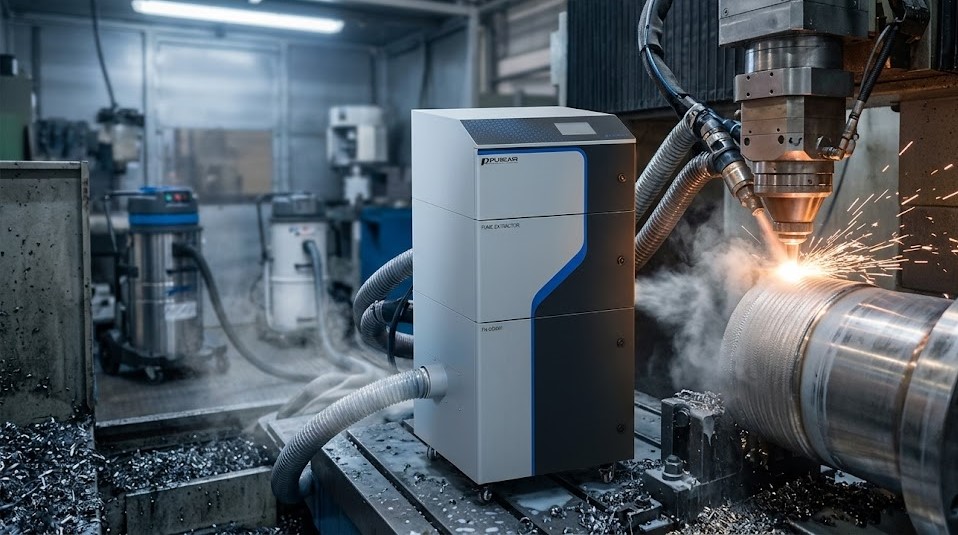
Instead of treating toxic metal particles like ordinary workshop debris, companies should install a high-efficiency laser cladding fume purification system designed specifically for industrial extraction applications. By using grounded, anti-stick composite filter elements, the system actively prevents pressure buildup, maintains stable airflow, and improves long-term equipment performance.
Moreover, advanced filtration technology helps protect workers from harmful carcinogenic heavy metals while simultaneously keeping laser tracks clean and highly accurate. As a result, manufacturers achieve more stable processing quality, reduced maintenance downtime, and safer production environments.
To support continuous and efficient manufacturing, PURE-AIR provides a comprehensive range of portable and centralized extraction solutions. Explore PURE-AIR’s advanced fume purification systems today and build a cleaner, safer, and more reliable production workflow.