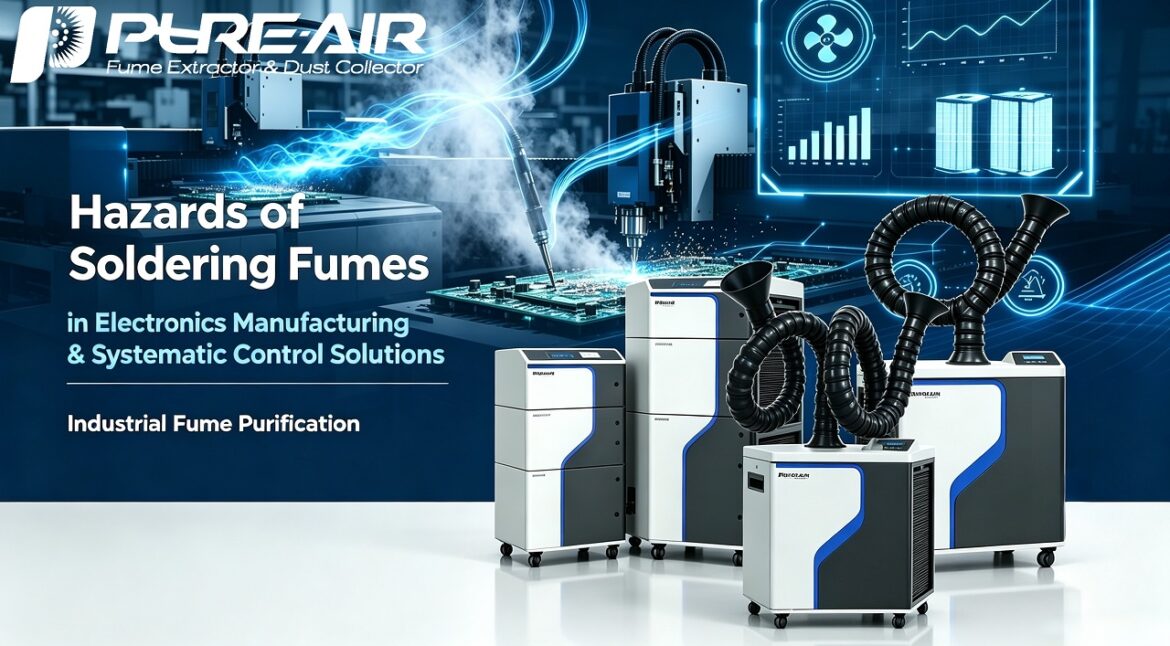
Hazards of Soldering Fumes in Electronics Manufacturing & Systematic Control Solutions
Soldering is a core process in PCB assembly, home appliance production and 3C electronics manufacturing. As industry capacity grows and occupational health & environmental standards become stricter, soldering fume control has become a key priority for compliant electronics workshop operations.
1. Pollutant Composition and Toxicity of Soldering Fumes
During soldering, solder wire and flux are vaporized at high temperatures and then rapidly condensed, forming a mixed fume system of solid particles and gaseous pollutants, which fall into two main categories: The first category is solid metal oxide particles. Metal components such as tin, copper and silver in the solder oxidize at high temperatures, forming ultrafine particles with a diameter of 0.1–1μm that can penetrate the respiratory tract directly into the alveoli and even enter the blood circulation. Although lead-free solder eliminates lead pollution, the respiratory damage risk of metal oxide dust remains.
The second category is volatile organic compounds (VOCs). Rosin resins, activators and organic solvents in the flux decompose when heated, releasing formaldehyde, benzene series and terpenes, which are the main source of the pungent odor at soldering stations. Short-term high-concentration exposure causes eye irritation, dizziness and nausea, while long-term exposure carries the risk of chronic nervous system damage.
According to the Occupational Exposure Limits for Hazardous Agents in the Workplace Part 1: Chemical Hazardous Agents (GBZ 2.1-2019), components such as tin and its inorganic compounds, toluene and xylene have clear time-weighted average allowable concentration limits. Open soldering stations without purification facilities generally carry the risk of exceeding standard concentrations.
2. Three Impacts of Uncontrolled Soldering Fumes on Enterprises
Inadequate soldering fume control brings not only environmental problems but also directly affects labor costs, compliance risks and production stability.
First, occupational health risks and rising labor costs. Long-term exposure to excessive soldering fumes significantly increases the incidence of respiratory diseases and allergic dermatitis among employees. Occupational disease diagnosis and compensation will greatly increase enterprise labor costs; at the same time, poor working conditions reduce job attractiveness and exacerbate frontline labor turnover.
Second, environmental compliance risks. The Standard for Controlling Fugitive Emissions of Volatile Organic Compounds (GB 37822-2019) clearly requires that production processes generating VOCs be equipped with exhaust gas collection and purification facilities, and fugitive discharge is prohibited. As a region with a dense electronics manufacturing industry, Dongguan lists soldering exhaust as a key item in daily environmental inspections. Non-compliant workshops may face administrative penalties and rectification deadlines, and in severe cases, normal production will be affected.
Third, reduced product yield and shortened equipment life. Ultrafine fumes deposited on PCB surfaces, component pins and testing equipment can cause micro-short circuits and poor contact, increasing product defect rates. At the same time, dust adhering to soldering iron tips, automated equipment guides and transmission parts accelerates mechanical wear and increases equipment maintenance frequency and spare parts costs.
3. Performance Comparison of Mainstream Soldering Fume Treatment Methods
There are various soldering fume treatment methods in the industry, with significant differences in technical routes and governance effects. Enterprises should select models based on their workstation scale, production characteristics and compliance requirements. Simple exhaust schemes are the initial choice for most small workshops, using desktop fans or duct exhaust to discharge fumes outdoors. This scheme has extremely low cost, but it essentially transfers pollutants rather than purifying them. It can neither eliminate the health hazards of ultrafine particles and VOCs nor meet environmental compliance requirements. It can only be used as a temporary auxiliary measure.
Single activated carbon adsorption schemes only target odor treatment, have very weak interception ability for metal particles, and dust will quickly block the pores of activated carbon, leading to rapid attenuation of adsorption efficiency and high filter replacement costs, which cannot achieve long-term stable compliance.
The 4-stage composite filtration solder fume extractor is the current mainstream compliant solution in the industry, which simultaneously treats particulate matter and VOCs through a gradient filtration structure. PureAiren solder fume extractors adopt a 4-stage structure: primary filter, medium efficiency filter, H13 HEPA high-efficiency filter, and high-iodine-value activated carbon adsorption. The filtration efficiency for 0.3μm particulate matter reaches 99.97%. At the same time, it directionally adsorbs rosin-based VOCs and odors. The purified gas can be directly circulated indoors without external exhaust, taking into account both compliance and energy saving.
4. Key Points for Implementing Systematic Soldering Fume Control
To achieve stable and up-to-standard governance, a complete system must be built from three dimensions: collection, purification and operation and maintenance, rather than relying solely on a single device. In the collection stage, collection devices must be matched according to the workstation form. Manual soldering stations are recommended to be equipped with flexible adjustable fume extraction arms to capture fumes at close range and control diffusion; automated equipment such as wave soldering and reflow soldering adopts closed gas collection hoods + duct collection to improve collection efficiency. The collection air speed must be controlled within a reasonable range: too low air speed will cause fume escape, while too high air speed will increase energy consumption and filter loss.
In the purification stage, the filter configuration must be matched according to the pollutant components.Standard 4-stage filtration is sufficient for ordinary lead-free soldering stations; for stations with high-volatility flux and lead-containing solder, the activated carbon filling volume should be increased to improve VOC treatment capacity; for high-cleanliness electronics workshops, additional terminal gas monitoring modules can be added to monitor emission concentration in real time. In the operation and maintenance stage, establishing a standardized filter replacement system is the key to ensuring long-term effects.
The primary filter can be washed with water regularly for repeated use, and HEPA filters and activated carbon filters need to be replaced regularly according to production load. Equipment equipped with intelligent differential pressure monitoring and filter warning functions can automatically identify filter blockage status, avoiding purification failure caused by untimely manual inspection.
Conclusion
Soldering fume control is the basic work for electronics manufacturing enterprises to implement occupational health and environmental compliance. Its core lies in shifting from “passive exhaust” to “active purification”. Adopting a professional solder fume extractor with 4-stage composite filtration, combined with accurate fume collection design and a standardized operation and maintenance system, can simultaneously meet occupational health limits and environmental protection emission standards, reduce enterprise labor and compliance risks, protect production equipment and stabilize product yield. Dongguan Pure-Air Tech Co.,Ltd provides full-scene solutions from single-station stand-alone machines to production line centralized purification for electronics workshops of different scales, helping enterprises achieve low-cost and sustainable fume control goals.
If you are looking for a high-performance fume extractor for your electronics workshop, or struggling with insufficient purification efficiency of your current soldering fume extractor, our technical team can provide targeted solutions tailored to your production scale.
Our Pure-Air fume extractor series adopts a 4-stage composite filtration structure to effectively capture fine soldering fumes and purify workshop air, fully compliant with global occupational health and environmental emission standards. If you want a reliable, cost-effective and long-lasting solder fume extractor, please feel free to reach out to our team for a customized solution and quotation.