Laser Fume Extractor: Protecting Workers, Equipment and Compliance in Laser Processing
Laser cutting, engraving and marking have become standard processes in sheet metal processing, advertising signage, acrylic products, hardware parts and many other industries. While laser processing brings high precision and efficiency, the fumes and dust generated during the process are often overlooked, much like soldering fumes were in early electronics manufacturing. For laser processing workshops, configuring a professional laser fume extractor is not only a guarantee of occupational health, but also a necessary measure to maintain equipment stability and meet environmental compliance requirements — just as a solder fume extractor has become essential for modern electronics production lines.
- Composition and Hazards of Fumes from Laser Processing
The fume components produced by laser processing vary greatly with different processing materials, but all have clear health and production risks.
When processing non-metallic materials such as acrylic, wood, leather and PVC with CO₂ lasers, the high-temperature vaporization of materials produces a large amount of oily fumes mixed with VOCs and irritating odors. Among them, harmful gases such as acrolein and benzene series will irritate the respiratory tract and eyes, and long-term inhalation will increase the risk of chronic respiratory diseases. Oily fumes will also adhere to the workshop walls, equipment surfaces and products, causing persistent environmental pollution.
When processing metal materials such as stainless steel, carbon steel and aluminum alloy with fiber lasers, a large amount of fine metal oxide dust will be generated. These dust particles are extremely small in size, can easily penetrate deep into the lungs, and some metal dusts also have heavy metal toxicity. In addition, accumulated metal dust has a certain risk of dust explosion when it reaches a certain concentration in a closed space.
In addition to health hazards, unfiltered laser fumes will directly affect production costs. Smoke that diffuses into the air will contaminate the laser lens, reducing the light transmittance and processing accuracy, and accelerating the wear and replacement frequency of the lens. Dust deposited inside the laser equipment will also block the guide rail and heat dissipation system, shortening the service life of the equipment.
- Common Misunderstandings of Laser Fume Treatment
Many laser processing workshops have insufficient understanding of fume control, and there are two typical treatment misunderstandings — mirroring the same missteps the electronics industry went through before the soldering fume extractor became a compliance staple.
The first is to rely solely on the exhaust fan for direct discharge. This method only discharges the fumes from the workshop to the outside, which essentially transfers pollution rather than purifying it. On the one hand, it will cause atmospheric pollution and easily trigger environmental complaints and penalties; on the other hand, the negative pressure formed by simple exhaust is uneven, and a large amount of fumes will still diffuse in the workshop, which cannot effectively protect the health of operators.
The second is to use a single filter device for general treatment. Some workshops use ordinary dust collectors to deal with laser fumes, but they ignore the compound components of laser fumes. For oily fumes and VOCs from non-metallic processing, a single dust removal filter cannot effectively intercept odors and gaseous pollutants, and the filter will be quickly blocked by oily fumes, resulting in a sharp decline in purification effect and high later maintenance costs.
- Why a Professional Laser Fume Extractor Is the Optimal Solution
A professional laser fume extraction system adopts a gradient composite filtration design, which can simultaneously treat particulate dust and gaseous pollutants, and is the mainstream compliant treatment scheme at present.
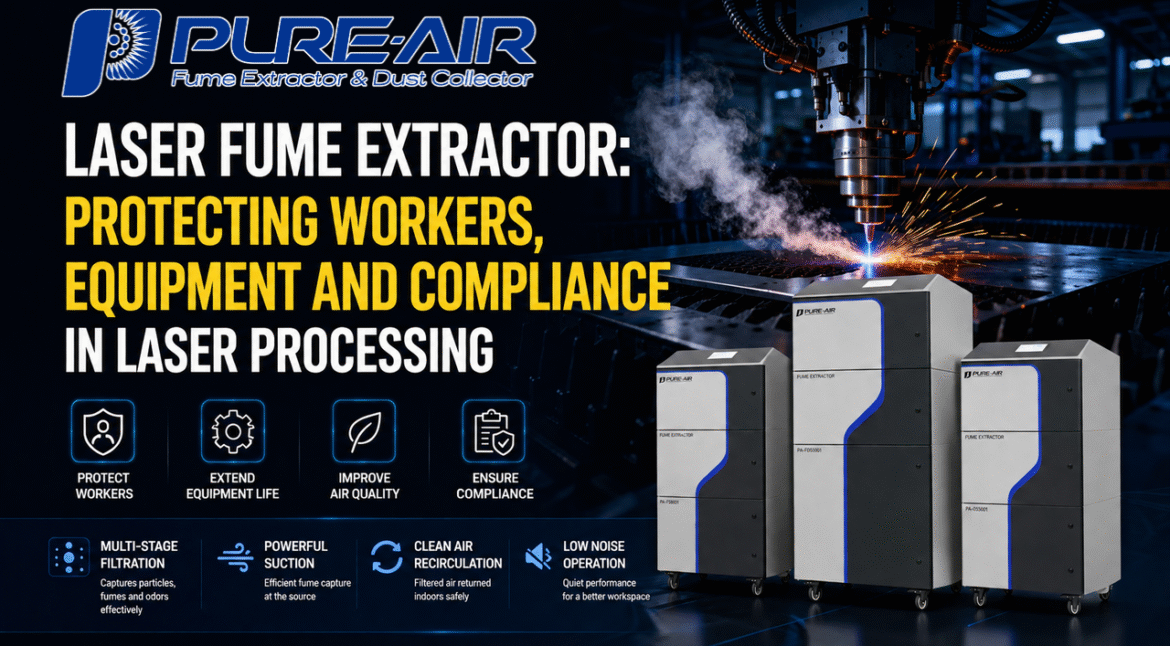
Pure-Air fume extractor series covers both laser processing and electronics soldering scenarios, applying the same proven gradient composite filtration technology across all product lines. Our laser-specific models adopt a reinforced multi-stage composite filtration structure, including a primary pre-filter layer, a medium-efficiency filtration layer, a high-efficiency HEPA filtration layer, and a high-capacity activated carbon adsorption layer. The pre-filter intercepts large particles of dust to extend the service life of the rear filter; the high-efficiency filter captures fine particulate matter; the activated carbon layer directionally adsorbs VOCs and irritating odors, so as to achieve comprehensive purification of laser fumes.
Compared with simple exhaust schemes, the closed source capture design of the fume extractor can directly collect fumes at the processing position, minimize the diffusion of fumes, and the purified air can be directly recirculated indoors without additional pipeline installation and external wall drilling — the same core advantage that makes our solder fume extractor a preferred choice for electronics workshops. For workshops with multiple laser devices, a centralized fume extraction system can also be adopted to uniformly treat the fumes of multiple stations through the main pipeline, reducing the overall equipment investment.
- Key Points for Selecting and Matching Laser Fume Extractors
When selecting a laser fume extractor, it is necessary to match the model according to the laser type, processing material and workstation scale, rather than blindly pursuing high air volume. Unlike a standard soldering fume extractor optimized for light rosin fumes and fine metal oxide particles, laser fume systems require more robust pre-filtration to handle heavy dust, oily residues and higher fume volumes.
First, match the filtration configuration according to the processing material. For non-metallic laser processing with more oily fumes and heavy odor, it is necessary to increase the filling amount of activated carbon and configure an oil-resistant pre-filter; for metal laser cutting with more dust, it is recommended to select a model with a filter self-cleaning function to reduce the frequency of manual filter replacement.
Second, match the air volume according to the laser power and the size of the processing table. Too small air volume will lead to incomplete fume collection, and too large air volume will cause unnecessary energy consumption and increase filter loss. A reasonable air volume matching can not only ensure the collection effect, but also control the operation cost.
Third, pay attention to the convenience of operation and maintenance. Models equipped with differential pressure monitoring and filter life reminder can automatically identify the filter blockage status, avoid the decline of purification efficiency caused by untimely filter replacement, and reduce the management pressure of workshop operation and maintenance.
Conclusion
Laser fume control is an indispensable part of the standardized management of laser processing workshops, just as solder fume management is non-negotiable for compliant electronics facilities. Relying on simple exhaust can no longer meet the current occupational health and environmental protection requirements. Configuring a professional laser fume extractor with multi-stage composite filtration, combined with targeted source capture design and standardized operation and maintenance management, can effectively protect the health of operators, extend the service life of laser equipment, and help workshops achieve long-term stable compliance production — the same compliance value delivered by a high-quality soldering fume extractor in electronics manufacturing.
If you are looking for a reliable fume extractor for your laser cutting or engraving workstation, or troubled by the poor purification effect of your current fume extraction equipment, we can provide targeted solutions according to your laser type and processing materials. Our Pure-Air fume extractor series covers both stand-alone models for single workstations and centralized systems for multi-station production lines, adapting to various laser processing scenarios as well as electronics soldering workstations. If you want to know more about our full range of fume purification solutions, including our industry-proven solder fume extractor lineup, please contact our team for detailed product introduction and quotation.