Print shop managers, safety officers, and printing equipment suppliers often focus on air quality in UV printing facilities. One common question is: Does UV curing generate ozone, and how can it be removed effectively?
During UV curing, ultraviolet light can react with oxygen in the surrounding air and produce ozone. Therefore, many printing facilities install a UV-curing ozone removal system to improve workplace air quality and support safe production.
If ozone is not controlled, it may affect employee comfort, equipment performance, and regulatory compliance. In contrast, a dedicated ozone extraction and filtration system captures ozone at the source before it spreads throughout the workspace. As a result, it helps maintain cleaner air and more stable production conditions.
This guide explains how UV curing produces ozone, the potential effects of ozone in printing environments, and how the FS-i series ozone removal system helps reduce ozone emissions through efficient air filtration technology.
1. The Invisible Secondary Pollutant: How UV Curing Generates Toxic Ozone Gas
To establish an effective environmental safety workflow, print shop owners must first understand the underlying physics that link ultraviolet radiation to chemical air pollution. During the standard drying phase, high-intensity industrial UV lamps emit short-wavelength ultraviolet radiation to instantly polymerize and dry custom inks.
[High-Intensity UV Lamp Radiation]
               |
               v
[Splits Ambient Oxygen Molecules (O2)]
               |
               v
[Free Oxygen Atoms Combine with O2] ---> Creates Toxic Ozone Gas (O3)
               |
               v (The Engineered Solution)
[FS-i Series Catalytic Activated Carbon] ---> Breaks O3 Down into Safe Oxygen (O2)
However, this powerful short-wave ultraviolet light strikes ambient oxygen molecules (O_2) floating in the air, splitting them into highly reactive single oxygen atoms. These free oxygen atoms quickly bond with remaining oxygen molecules, creating large quantities of ozone gas (O_3). This colorless, highly reactive gas functions as an inevitable byproduct of traditional mercury vapor UV lamps, generating a strong chemical smell that spreads through the print room.
2. Health Hazards and Machinery Erosion: The Twofold Threat of Ozone Build-up
Uncontrolled ozone accumulation inside a commercial printing facility creates two major risks: severe worker health problems and rapid mechanical damage to your equipment.
Acute Worker Health Risks
Ozone gas has a distinct, pungent, fishy odor that human noses can easily detect even at very low concentrations. If a facility lacks proper ventilation or a dedicated UV ink odor extraction system, workers will experience serious health issues from breathing the gas.
Even brief exposure to elevated ozone levels irritates the nose and throat, causing persistent coughing, shortness of breath, and chest tightness. Over time, breathing this gas weakens lung function, increases the severity of asthma symptoms, and leads to chronic respiratory fatigue among your press operators.
Rapid Equipment and Structural Corrosion
Beyond damaging human health, ozone acts as a powerful oxidizing agent that actively attacks your physical factory assets. The gas aggressively breaks down organic materials, which accelerates the aging and cracking of flexible rubber rollers, structural seals, and suction belts inside your printing presses.
Furthermore, ozone corrodes exposed copper wires and delicate electronic circuits within the main control panels. This chemical attack leads to unexpected electrical faults, costly control board failures, and expensive emergency maintenance downtime.
3. The FS-i Engineering Solution: Advanced Catalytic Carbon Neutralization
The FS-i series portable dust collector for printing eliminates these dual threats by using a high-efficiency, multi-stage filtration system specifically designed to handle industrial gaseous pollutants.
[Raw UV Exhaust Air] -> [High-Efficiency HEPA Filtration] -> [Activated Carbon Layer] -> [Safe Pure Air Output]
Specialized Activated Carbon Neutralization
While standard dust filters only trap solid airborne particles, the FS-i series features a heavy-duty, chemically modified activated carbon layer that eliminates gases. Technicians treat this premium carbon matrix using a specialized activation process that greatly expands its internal surface area and creates microscopic pores.
When the vacuum motor pulls the ozone-filled exhaust through this filter, the activated carbon acts as a powerful catalyst. It triggers a rapid chemical reaction that safely converts toxic ozone (O_3) back into stable, breathable oxygen (O_2), removing the gas without releasing any secondary chemical pollutants into your workspace.
Synergistic HEPA Particulate Capture
The FS-i series pairs this gas-neutralizing carbon layer with a medical-grade HEPA filter block to provide complete protection. While the carbon bed breaks down ozone molecules and chemical ink odors, the high-efficiency HEPA filter traps tiny airborne ink mists, paper dust, and ultrafine particles. This multi-stage setup cleans the messy exhaust completely, allowing your print shop to easily pass strict government air quality audits.
Industrial Air Filtration Sourcing Performance Metrics
| Operational Sourcing Factors | Standard Workplace Exhaust Fans | FS-i Series Industrial Filtration Units |
| Ozone Gas Removal Efficiency | Low; merely dilutes gas by venting it elsewhere | High: achieves greater than 99% catalytic neutralization |
| Ink Odor & VOC Capture | Ineffective; allows strong odors to linger in the area | Excellent; heavy-duty carbon absorbs volatile compounds |
| Particulate Filtration Level | Zero filtration allows fine dust to settle on wet ink | Certified HEPA; traps 99.97% of fine airborne printing dust |
| Mobility and Installation | Fixed wall mounting; requires complex exterior ducting | Compact portable design; rolls easily between printer stations |
| Regulatory Compliance Status | Frequently violates outdoor environmental emission codes | Safely exhausts clean, filtered air directly back into the room |
4. Strategic Air Quality Guidelines for Printing Equipment Distributors
Industrial equipment distributors can protect their clients’ operations and secure steady repeat business by enforcing three strict air safety guidelines during every printer sale:
-
Identify the True Source of the Odor: Remind your printing clients that strong shop odors are not just an annoyance—they indicate the presence of toxic ozone and volatile organic compounds (VOCs) that require active carbon filtration.
-
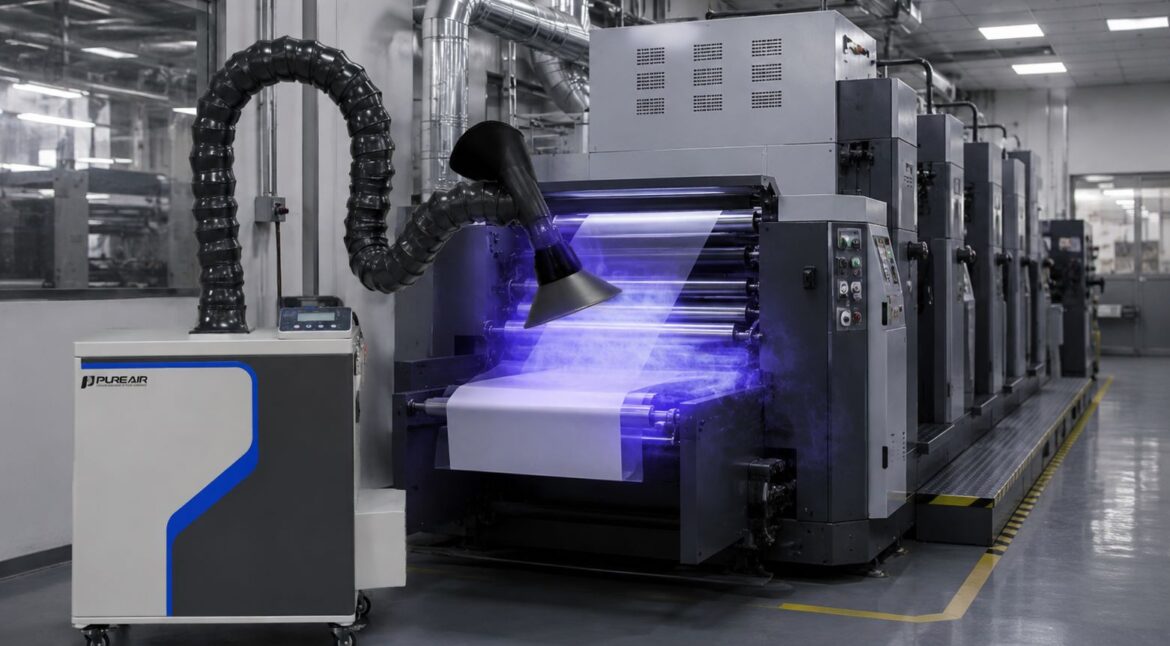
Deploy Dedicated Source Capture Units: Avoid relying on weak ceiling exhaust fans that pull contaminated air past the operators’ breathing zones. Instead, position a portable extractor intake right next to the UV lamp housing to trap pollutants the moment they form.
-
Establish Routine Filter Maintenance Schedules: Help your clients set up regular filter replacement intervals based on their weekly production hours. Replacing saturated carbon blocks on time ensures the system maintains high ozone neutralization rates and keeps the air clean.
Conclusion: Future-Proof Your Printing Facility Against Air Quality Hazards
In conclusion, maintaining a highly profitable, modern printing facility requires choosing an advanced extraction system that neutralizes the invisible gas hazards generated by high-power UV lamps.
Stop risking your operating capital, employee health, and expensive machinery components on cheap, basic ventilation fans that simply move toxic air around your shop floor. Upgrading your print lines with our high-efficiency UV curing printing ozone removal systems guarantees complete gas neutralization, total ink odor elimination, and pristine, dust-free production air across every shift. We test every carbon layer and optimize every extraction motor to ensure your facility comfortably meets the highest international workplace safety standards.
Contact our industrial air filtration division today to share your press specifications and receive a detailed equipment configuration quote.