Industrial Laser Fume Extractor: Protecting Commercial Workshops from Fume Hazards
Laser cutting, engraving, and marking technologies are now widely used across sheet metal fabrication, advertising signage, acrylic processing, hardware manufacturing, and packaging industries.
As more commercial workshops expand their laser processing capacity, the fumes and dust generated during production have become an unignorable occupational health and environmental compliance issue. Deploying a professional industrial laser fume extractor has become a foundational requirement for standardized laser workshop operations.
1.Health and Production Risks of Uncontrolled Laser Fumes
Laser fumes are formed when materials are vaporized by high-energy laser beams and then rapidly condensed in the air. Their composition varies significantly by processing material, but all pose measurable risks to workers, equipment, and compliance.
When processing non-metallic materials such as acrylic, PVC, wood, and leather with CO₂ lasers, large amounts of oily fumes mixed with volatile organic compounds (VOCs) and irritating odors are released. Harmful substances like acrolein, benzene series, and formaldehyde directly irritate the eyes and respiratory tract. Long-term exposure increases the risk of chronic respiratory diseases and nervous system damage. Oily fumes also adhere to workshop walls, product surfaces, and equipment, creating persistent environmental pollution that is difficult to clean.
When processing metals such as stainless steel, carbon steel, and aluminum alloy with fiber lasers, fine metal oxide dust is produced in large quantities. Most of these particles are ultrafine in size, which can penetrate deep into the alveoli and even enter the bloodstream, carrying heavy metal toxicity. In enclosed spaces, accumulated metal dust at sufficient concentrations also presents a potential dust explosion risk.
Beyond health hazards, unfiltered fumes directly raise operating costs. Diffused smoke contaminates laser lenses, reducing light transmittance and machining accuracy while accelerating lens wear and replacement. Dust settling inside laser equipment blocks guide rails and heat dissipation systems, shortening equipment service life and increasing maintenance expenses.
2.Why Simple Ventilation Fails to Meet Commercial Workshop Needs
Many commercial workshops initially use basic exhaust fans or window ventilation to handle laser fumes, but these methods have critical limitations and cannot meet long-term compliance requirements.
First, simple exhaust only transfers pollutants rather than purifying them. Discharging untreated fumes directly outdoors causes atmospheric pollution, which easily triggers environmental complaints and administrative penalties under current VOC emission control regulations. For commercial workshops in industrial zones, unregulated exhaust is one of the most common causes of environmental non-compliance.
Second, open ventilation cannot achieve effective fume containment. The negative pressure generated by exhaust fans is unevenly distributed, and a large portion of fumes still diffuse throughout the workshop before being discharged, meaning operators still inhale harmful substances during work.
Some workshops also attempt to use ordinary air purifiers for fume treatment. However, a standard laser air purifier designed for general indoor air quality lacks specialized pre-filtration and heavy-duty adsorption structures. It quickly becomes clogged by oily fumes and dense dust, leading to rapidly declining purification efficiency and high filter replacement costs.
3.Advantages of Professional Industrial Laser Fume Extractors
A professional industrial laser fume extractor adopts a gradient composite filtration design, which is currently the mainstream compliant solution for commercial laser processing workshops.
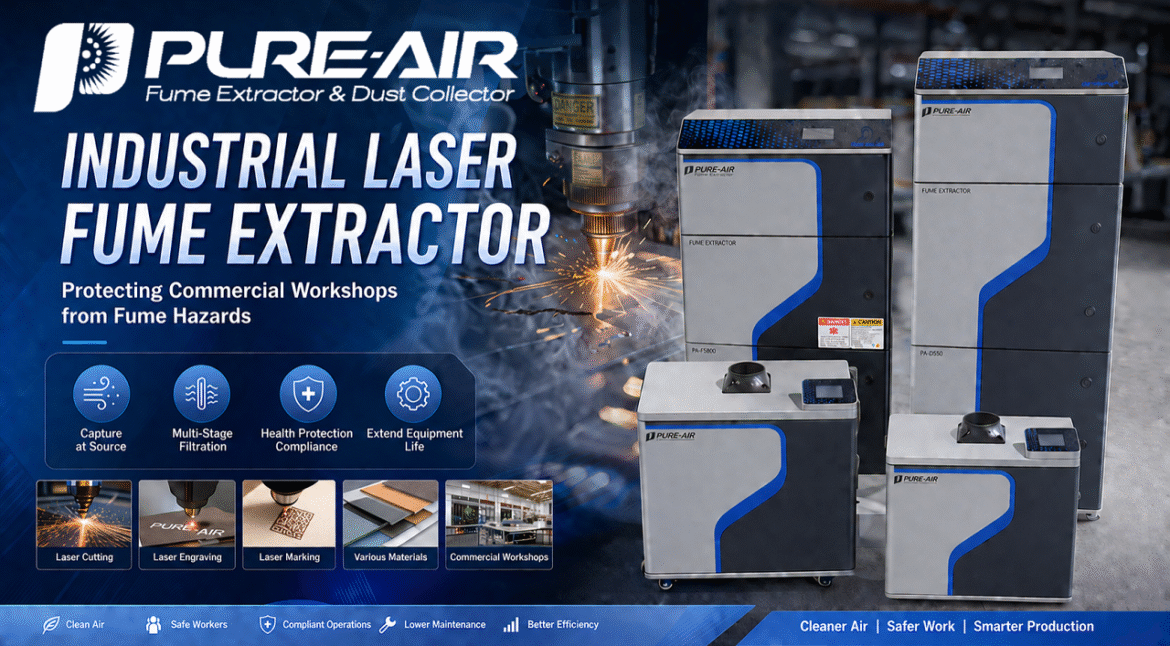
The laser smoke purifier system from Pure-Air uses a four-stage composite filtration structure: a primary pre-filter, a medium-efficiency filter, a high-efficiency HEPA filter, and a high-capacity activated carbon adsorption layer. The pre-filter intercepts large dust particles and oily residues to extend the service life of rear filters. The HEPA filter captures fine particulate matter, while the activated carbon layer directionally adsorbs VOCs and irritating odors, achieving comprehensive purification of both particulate and gaseous pollutants.
Compared with simple ventilation schemes, the closed source-capture design of the commercial laser fume extractor collects fumes directly at the processing point, minimizing fume diffusion. Purified air can be recirculated indoors without the need for external ductwork or wall drilling, making deployment flexible and energy-efficient. For multi-machine workshops, centralized fume extraction systems are available, which treat fumes from multiple stations through a main pipeline to reduce overall equipment investment.
4.Key Selection Criteria for Commercial Laser Workshops
Choosing the right industrial laser fume extractor requires matching the model to your laser type, processing materials, and workstation scale, rather than blindly pursuing high air volume.
First, select the filtration configuration based on processing materials. For workshops processing mostly non-metallic materials with heavy oily fumes and strong odors, models with increased activated carbon filling volume and oil-resistant pre-filters are recommended. For workshops focused on metal laser cutting with high dust output, models with filter self-cleaning functions can reduce manual maintenance frequency.
Second, match air volume to laser power and processing table size. Insufficient air volume leads to incomplete fume capture, while excessive air volume wastes energy and accelerates filter consumption. A properly sized air volume ensures both capture performance and reasonable operating costs.
Third, prioritize models with intelligent operation and maintenance features. Devices equipped with differential pressure monitoring and filter life reminders can automatically detect filter clogging status, avoiding purification performance degradation caused by delayed filter replacement and reducing workshop management workload.
Conclusion
Laser fume management is an essential part of standardized management for commercial laser processing workshops. Basic ventilation and general-purpose air purification solutions can no longer satisfy current occupational health and environmental compliance standards.
Equipping your workshop with a professional industrial laser fume extractor with multi-stage composite filtration, paired with targeted source capture design and standardized operation and maintenance, can effectively protect worker health, extend laser equipment service life, and ensure long-term compliant production.
If you are looking for a reliable commercial laser fume extractor for your workshop, or if your current fume treatment system is failing to meet compliance requirements, our technical team can provide a customized solution based on your laser equipment and processing materials.
Our Pure-Air laser smoke purifier portfolio covers everything from single-station units to centralized systems for entire production lines, adapting to all common laser processing scenarios. To learn more about our industrial laser fume extractor solutions and receive a detailed quotation, please contact our team.