In modern manufacturing facilities, commercial print shops, and electronics assembly plants, effective air filtration is essential for maintaining indoor air quality, protecting employees, and supporting environmental health and safety (EHS) requirements.
When selecting an industrial fume extraction solution, facility managers often face a fundamental question: Should they install a centralized ducted dust collection system or use portable fume extractors for source capture?
The right choice depends on factors such as production layout, installation requirements, emission sources, facility size, and the frequency of equipment relocation. While centralized systems can provide facility-wide extraction, portable fume extractors offer greater installation flexibility and point-of-source filtration, particularly for production environments that frequently change.
Portable Fume Extractor vs. Centralized Extraction System
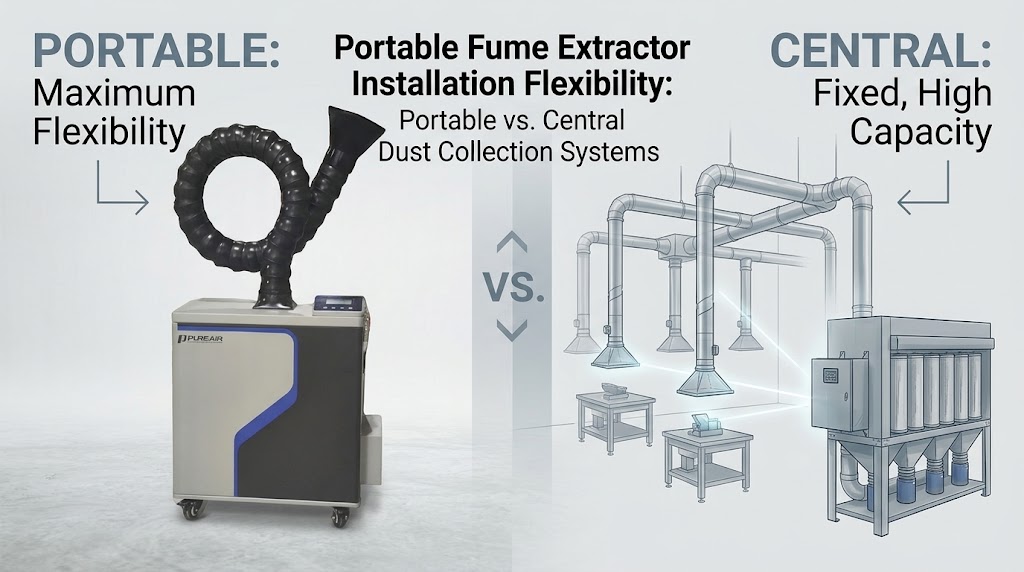
A centralized dust collection system typically relies on fixed ductwork to connect multiple production machines to a central blower and filtration unit. This configuration can work well in large, stable facilities with permanent equipment layouts. However, the fixed infrastructure can become a limitation when production lines are frequently modified.
By contrast, a portable fume extractor captures airborne contaminants directly at or near the emission source. It can be repositioned as equipment layouts change without requiring extensive building modifications.
Centralized Dust Collection System
- Fixed duct network: Requires permanent ductwork, wall penetrations, roof openings, or structural modifications.
- Higher installation requirements: Duct design, fabrication, installation, and commissioning can significantly increase project costs.
- Limited layout flexibility: Relocating production equipment may require duct extensions, rerouting, or system redesign.
- Centralized maintenance: A single extraction system may require coordinated maintenance across multiple production areas.
Portable Fume Extractor
- Plug-and-play installation: Can be installed near the emission source without extensive wall or roof modifications.
- Point-of-source extraction: Captures fumes, VOCs, ozone, and airborne particles before they spread throughout the workspace.
- Easy relocation: Units can move with printing machines, curing equipment, or other production stations.
- Compact footprint: Suitable for production environments where available floor space is limited.
Why Production Layout Matters When Choosing an Industrial Fume Extractor
Production flexibility is an increasingly important consideration for modern manufacturing facilities.
UV printing facilities, digital printing plants, laser processing workshops, and PCB assembly environments may regularly add equipment, relocate production lines, or modify workflows. A fixed duct system must be designed around a relatively stable layout, while a portable extraction system can adapt to these changes.
1. Reducing the Cost of Production Layout Changes
In a centralized extraction system, each machine is generally connected to the main duct network through fixed extraction lines. When a machine is relocated, the existing ductwork may no longer align with the new emission source.
The modification process can involve:
- Removing existing duct sections
- Installing new metal ductwork
- Modifying wall or ceiling penetrations
- Rebalancing airflow
- Recommissioning the extraction system
- Scheduling additional installation labor
These modifications can increase project costs and create production downtime.
A portable fume extractor eliminates much of this fixed infrastructure. Operators can reposition the extraction unit alongside the equipment that generates fumes or airborne contaminants, making it particularly useful for facilities with changing production layouts.
2. Fast Installation Without Major Structural Modifications
Portable industrial fume extractors can be installed directly at the source of emissions without requiring extensive building alterations.
This installation approach is particularly useful for:
- Leased manufacturing facilities
- Temporary production areas
- Commercial printing facilities
- Small and medium-sized workshops
- Facilities with restricted construction permissions
- Production lines undergoing frequent reconfiguration
Instead of building a permanent duct network, manufacturers can establish localized extraction where it is needed.
Compact Design for Space-Constrained Production Areas
Floor space is often limited around digital printers, UV curing systems, and industrial processing equipment.
The PURE-AIR FS-i Series uses a compact housing designed to reduce its required installation footprint by up to 40% compared with larger extraction configurations.
This allows the unit to be positioned close to:
- UV inkjet printers
- Digital printing presses
- UV curing stations
- Industrial inkjet equipment
- Commercial printing machinery
- Other localized fume-generating processes
Placing the extractor close to the emission source can also reduce the need for long extraction ducts and help maintain a more direct airflow path.
High Negative Pressure for VOC, Ozone, and Ink Mist Capture
UV printing and inkjet printing processes can generate a mixture of airborne contaminants, including volatile organic compounds (VOCs), solvent vapors, ozone, and fine ink mist. As these contaminants can quickly disperse into the operator’s breathing zone, effective source capture plays a critical role in maintaining a cleaner production environment.
To address this challenge, the FS-i Series generates high negative pressure to support localized fume extraction directly at the source. In addition, its PIPS multi-stage filtration system helps capture airborne contaminants before they spread throughout the workspace.
As a result, this source-capture approach can help limit the dispersion of printing fumes, VOC-related vapors, and fine airborne particles, while supporting more effective air quality management across the production area.
EHS, Indoor Air Quality, and Operator Protection
Industrial air filtration involves more than selecting the right filtration equipment. Instead, it plays an essential role in EHS compliance and indoor air quality management.
Therefore, facilities should first identify specific contaminants, exposure levels, and ventilation conditions. In addition, teams should evaluate applicable occupational exposure limits and local regulations. By considering these factors together, facilities can design an effective air treatment system that supports cleaner air and safer working environments.
1. Supporting Workplace Air Quality
Uncontrolled solvent vapors, VOCs, ozone, and fine particulates can negatively affect workplace air quality.
A properly configured industrial fume extraction system can capture contaminants at the source before they disperse throughout the facility.
For this reason, source-capture extraction can complement a facility’s general ventilation system and other workplace exposure-control measures.
Important: Filtration equipment should be selected according to the actual contaminant type, concentration, airflow requirement, and applicable regulatory requirements. Equipment performance should not be interpreted as an automatic guarantee of regulatory compliance.
2. Protecting Printing Quality
Airborne ink mist and particulates can also affect production quality.
If contaminants accumulate around printing equipment, they may contribute to:
- Print surface contamination
- Print defects
- Equipment fouling
- Printhead maintenance requirements
- Material waste
By capturing emissions near the printing process, a portable fume extraction system can help maintain a cleaner production environment and support more consistent printing operations.
Portable Fume Extractor vs. Centralized Dust Collection: Which Should You Choose?
The decision between a centralized dust collection system and a portable fume extractor should be based on the facility’s operating conditions rather than equipment type alone.
| Evaluation Factor | Centralized Dust Collection | Portable Fume Extractor |
|---|---|---|
| Installation | Requires fixed ductwork | Minimal structural modification |
| Layout flexibility | Limited | High |
| Equipment relocation | May require duct modification | Easy to reposition |
| Source capture | Possible through fixed connections | Designed for localized extraction |
| Initial infrastructure | Higher | Lower for localized applications |
| Space requirements | Requires duct routing and central equipment | Compact point-of-use design |
| Best suited for | Stable, large-scale facilities | Flexible or changing production environments |
| Maintenance approach | Centralized system maintenance | Individual unit maintenance |
Choose a Centralized System When:
A centralized extraction system may be appropriate when:
- Production equipment has a stable layout.
- Multiple machines require permanent extraction.
- The facility has sufficient space for ductwork.
- A large-scale, facility-wide extraction network is required.
- Long-term infrastructure investment is justified.
Choose Portable Fume Extractors When:
Portable extraction can be advantageous when:
- Production equipment is frequently relocated.
- The facility operates in a leased building.
- Structural modifications are restricted.
- Extraction is required at individual workstations.
- Fast installation is important.
- Floor space and installation flexibility are major considerations.
Conclusion
The choice between a portable fume extractor and a centralized dust collection system ultimately depends on the facility’s layout, emission sources, production scale, and long-term infrastructure requirements.
Centralized systems can be effective for large facilities with stable production layouts and multiple permanent extraction points. However, they require greater infrastructure investment and can be difficult to modify when production equipment moves.
For facilities that prioritize flexible installation, source-capture filtration, rapid deployment, and minimal structural modification, portable fume extractors provide a practical alternative.
With compact equipment design, high negative-pressure extraction, and multi-stage filtration, the PURE-AIR FS-i Series provides a flexible air purification solution for modern printing and manufacturing environments.
PURE-AIR supports industrial customers with portable fume extraction and air purification solutions engineered around specific application requirements, helping manufacturers build cleaner, more adaptable production environments.