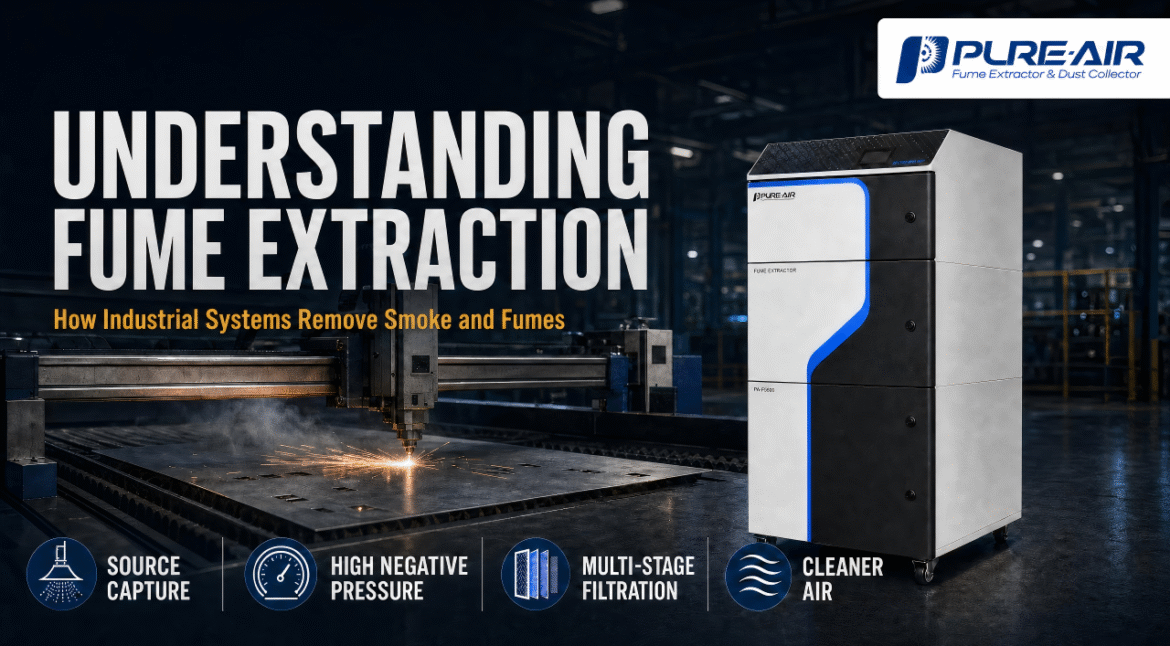
Understanding fume extraction: How Industrial Systems Remove Smoke and Fumes
Industrial manufacturing processes such as laser cutting, welding, soldering, grinding, engraving, and metal processing inevitably generate airborne contaminants. Depending on the process and materials involved, these contaminants may include fine particulate matter, metal fumes, smoke, dust, VOCs, and odors. If they are not effectively controlled, they can spread throughout the production area, affecting workplace air quality, equipment cleanliness, production efficiency, and employee comfort.
This is where professional fume extraction becomes essential. Unlike general ventilation, which mainly dilutes contaminated air, an industrial fume extraction system is designed to capture pollutants as close as possible to their source and then transport them through a dedicated filtration system. Source capture is widely recognized as an important engineering approach for controlling airborne contaminants because it prevents fumes from dispersing into the wider working environment.
For manufacturers, understanding how a fume extraction system works is important when selecting the right equipment. A complete solution is not simply a fan or a filter—it is a coordinated system involving source capture, airflow, negative pressure, multi-stage filtration, and intelligent monitoring.
1. What Is fume extraction and Why Is Source Capture Important?
fume extraction refers to the process of capturing smoke, fumes, dust, and other airborne contaminants from industrial processes before they spread into the surrounding workplace. A typical system consists of a capture hood, extraction arm or enclosed workstation, a fan or blower, filtration stages, and a control system.
The most important principle is source capture. Instead of allowing fumes to disperse throughout the workshop and attempting to clean the entire room afterward, the extraction point is positioned close to where contaminants are generated. This reduces the amount of contaminated air entering the worker’s breathing zone and allows the system to remove pollutants more efficiently. OSHA guidance for welding and cutting specifically emphasizes local exhaust systems that remove fumes and smoke at the source.
For example, a laser cutting machine may use an enclosed extraction connection to remove smoke directly from the processing chamber. A welding workstation may use a flexible extraction arm positioned near the welding area, while a soldering workstation may use a compact capture nozzle or benchtop extraction system.
The terms smoke eater and smoke purifier are also commonly used when discussing equipment designed to remove smoke and airborne contaminants. However, professional industrial fume extraction goes beyond simply removing visible smoke. The system needs to address the specific characteristics of the contaminants, provide sufficient capture performance, and use an appropriate filtration configuration.
A properly designed system therefore follows a basic principle:
Capture at the Source → Convey Contaminated Air → Filter the Pollutants → Discharge Cleaned Air
Each stage has an important role in determining the overall performance of the system.
2. How an Industrial fume extraction System Works
Once fumes are captured, the extraction system needs to move the contaminated air through the filtration unit. This requires a fan capable of maintaining sufficient airflow and negative pressure under actual operating conditions.
Airflow is important because it determines how much contaminated air can be moved through the system. However, airflow alone does not determine extraction performance. The system must also overcome resistance caused by hoses, ducts, bends, hoods, filters, and filter loading. This is why high negative pressure performance is particularly important in demanding industrial applications.
PURE-AIR develops its own High Negative Pressure Fan Technology to provide powerful and stable suction for industrial fume extraction applications. The objective is not simply to generate a large amount of airflow, but to maintain effective source capture under real operating conditions.
After contaminated air enters the equipment, it passes through a multi-stage filtration system. Different filtration stages are designed to handle different types and sizes of contaminants. A pre-filter can capture larger particles and protect downstream filters from excessive loading. Fine-particle and HEPA filtration can then remove smaller airborne particles, while activated carbon can be incorporated when adsorption of certain VOCs or odors is required.
This multi-stage approach is important because industrial fumes are often complex mixtures rather than a single type of pollutant. OSHA guidance on local exhaust and filtration also highlights the importance of suitable system design, maintenance, and filtration performance for controlling airborne contaminants.
After filtration, the treated air may either be returned to the workplace or discharged externally, depending on the contaminant characteristics, system design, and applicable local requirements. The final air-handling approach should always be determined according to the specific application and relevant regulations.
3. What Makes a Professional fume extraction System Different?
A professional fume extraction system is more than a combination of a fan and filter. Its performance depends on how well the capture, airflow, filtration, and control technologies work together.
First, the system must provide effective source capture. Poorly positioned extraction points can allow fumes to escape before they reach the filtration unit. Second, the fan must provide sufficient negative pressure to maintain stable extraction performance. Third, the filtration configuration must match the actual contaminants. Using a general dust filter for applications that generate fine particles, oily fumes, or gaseous contaminants may result in poor purification performance and premature filter loading.
Filter management is another important consideration. As a filter accumulates contaminants, its resistance increases. If the system does not compensate for this change, airflow can gradually decline and extraction performance may deteriorate. This is why advanced industrial systems increasingly use intelligent monitoring and control.
PURE-AIR’s PIPS Intelligent Purification System is designed to monitor key operating parameters and optimize system performance. Depending on the equipment configuration, PIPS can monitor airflow, negative pressure, filter status, and system operating conditions. Intelligent airflow compensation helps maintain stable extraction performance as filter resistance changes, while filter status monitoring and system alerts assist operators with timely maintenance.
This combination of High Negative Pressure Fan + PIPS Intelligent Purification System + Large-Capacity Long-Life Filters allows PURE-AIR to approach fume extraction as a complete engineering system rather than simply a filtration device.
For manufacturers, this can provide several long-term advantages, including more stable extraction performance, better filter utilization, reduced maintenance requirements, and improved equipment reliability.
4. How to Choose the Right fume extraction Solution
The correct system should always be selected according to the actual production process. Before purchasing a fume extractor, manufacturers should first identify the type of contaminants being generated, the amount of fumes produced, the number of operating stations, the required capture method, and the working environment.
For individual workstations, portable or compact fume extraction equipment may provide the flexibility required for welding, soldering, laser marking, or repair applications. For larger production facilities with multiple machines, a centralized fume extraction system may be more appropriate.
The filtration configuration should also be selected according to the contaminant characteristics. Laser processing, welding, soldering, grinding, and other manufacturing processes can produce very different airborne pollutants. Therefore, simply choosing a system based on maximum airflow or the lowest equipment price may result in poor long-term performance.
Manufacturers should also evaluate the total operating cost, including energy consumption, filter replacement, maintenance, and downtime. A system with a lower initial fume extractor price is not necessarily the most economical solution over its entire service life.
A professional supplier should be able to evaluate the application and recommend an appropriate combination of capture method, airflow, negative pressure, filtration, and control technology.
Conclusion
Effective industrial air purification starts with effective fume extraction. Instead of allowing smoke and fumes to spread throughout the workshop, a professional system captures contaminants at their source, transports them through a properly designed filtration system, and continuously manages extraction performance.
Understanding the complete process—from source capture and high negative pressure to multi-stage filtration and intelligent monitoring—can help manufacturers make better decisions when selecting an industrial fume extraction system.
With more than 15 years of experience in industrial fume extraction and air purification, PURE-AIR combines self-developed High Negative Pressure Fan Technology, the PIPS Intelligent Purification System, and Large-Capacity Long-Life Filters to provide professional solutions for laser processing, welding, soldering, metal fabrication, and other industrial applications.
If you are struggling with the poor performance of your current fume extractor, unstable airflow, frequent filter replacement, or inadequate smoke and fume removal, contact our team. PURE-AIR can evaluate your application and help you find a more reliable and efficient fume extraction solution.