
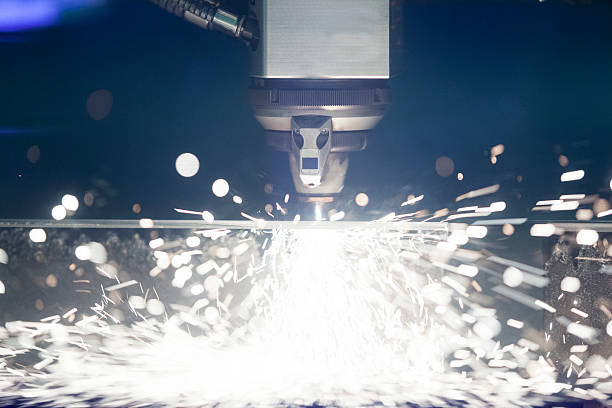
In the vanguard of advanced manufacturing, laser cutting and metal 3D printing (Additive Manufacturing) have revolutionized production speed and geometric complexity. However, these high-energy processes generate a byproduct that is as dangerous as it is invisible: sub-micron metallic fumes and plastic aerosols. These particles, often smaller than $0.1\mu m$ (nanoparticles), possess the ability to bypass traditional filtration systems, settle deep within human lung tissue, and contaminate the high-precision optical components of the machinery itself.
To address this challenge, industrial safety requires more than a simple filter; it demands a comprehensive “Triple Molecular Sieve” Defense. By integrating spark interception, coalescing pre-filtration, and high-efficiency PTFE-membrane technology, modern fume filtration units create a tiered barrier that ensures near-zero emissions. This article dissects the engineering logic of this three-stage defense and how it safeguards both human health and equipment longevity.
1. The Invisible Threat: Why Sub-Micron Particles are Different
Traditional industrial dust, such as wood shavings or coarse grinding debris, is relatively easy to capture due to its mass. In contrast, laser cutting and 3D printing utilize high-energy beams to vaporize material. As this vapor cools, it undergoes a process of nucleation and agglomeration, forming ultra-fine particles (UFPs).
The Nano-Scale Hazard
Particles smaller than $0.1\mu m$ behave differently from larger dust. They do not settle under gravity; instead, they remain suspended in the air indefinitely, following Brownian motion.
-
Human Health: These sub-micron particles can cross the blood-brain barrier and enter the circulatory system directly via the alveoli.
-
Machine Integrity: In laser systems, these oily, conductive fumes can settle on lenses and mirrors, leading to beam distortion, overheating, and costly hardware failure.
To combat this, fume filtration units must act as a “molecular sieve,” catching the finest contaminants while maintaining a high airflow rate.
2. Stage I: The Spark Arrestor and Inertial Interceptor
The first line of defense is not about filtration, but about Risk Mitigation and Thermal Management. Laser cutting and metal 3D printing often produce incandescent sparks or hot, unoxidized metallic dust.
Fire Prevention and Cooling
If these sparks reach the main filter chamber, they pose an immediate fire risk. The “First Sieve” utilizes a labyrinth-style spark arrestor. By forcing the air through a series of rapid directional changes, the system uses the particle’s own inertia to strike internal baffles.
-
Action: This collision cools the hot particles and extinguishes embers.
-
Effect: Heavier debris drops into a collection bin before reaching the delicate primary filters, significantly extending the lifespan of the entire system.
3. Stage II: Coalescing Filtration and Aerosol Separation
In 3D printing, especially when using polymer resins or oil-treated metal powders, the fumes contain “aerosols”—tiny liquid droplets suspended in the gas. These are the “sticky” contaminants that clog traditional dry filters instantly.
The Agglomeration Strategy
The second stage of the defense focuses on Coalescing Filtration. Using specialized deep-bed media, the system encourages tiny liquid droplets to collide and merge into larger, heavier drops.
-
Function: As these droplets grow, they lose their ability to remain airborne and drain away into a specialized separator.
-
Protection: This stage removes the “sticky” fraction of the fume, ensuring that the final, high-efficiency stage remains dry and free-flowing. Without this coalescing step, the primary filter would suffer from “blinding,” where the pores are sealed by a layer of oily film.
4. Stage III: PTFE-Coated HEPA Filtration (The Zero-Emission Shield)
The final and most critical stage of the fume filtration units is the high-precision filter cartridge. For sub-micron fumes, standard cellulose or polyester filters are insufficient. The industry standard for “zero-emission” performance is PTFE (Polytetrafluoroethylene) Membrane Technology.
Surface Filtration vs. Depth Filtration
Traditional filters trap dust inside the fibers (depth filtration), which makes it impossible to clean. However, PTFE-coated media utilize Surface Filtration.
-
Micro-Pore Precision: The PTFE membrane features billions of microscopic pores that are significantly smaller than the particles being captured.
-
Efficiency: This allows the system to achieve a filtration efficiency of 99.97% at $0.3\mu m$, effectively “sieving” out the sub-micron metallic fumes produced by laser vaporization.
-
Self-Cleaning Ability: Because the dust sits on the “non-stick” PTFE surface rather than inside the fibers, the system’s pulse-jet cleaning mechanism can easily blow the dust off, restoring the filter’s breathability and maintaining a constant suction pressure.
5. Maintaining the Defense: Intelligent Pressure Management
A triple-stage defense is only effective if the airflow remains consistent. As the “sieves” capture more material, the internal resistance (static pressure) increases.
Differential Pressure Monitoring
Modern fume filtration units incorporate intelligent sensors that monitor the pressure drop across each stage.
-
Stage 1 Monitoring: Ensures the spark arrestor isn’t blocked by heavy debris.
-
Stage 3 Monitoring: Triggers the automatic pulse-cleaning cycle when the PTFE membrane becomes saturated.
-
Variable Frequency Drive (VFD): The system automatically increases motor speed as filters fill up, ensuring the capture velocity at the laser head remains identical whether the filters are new or used. This prevents the “sneaky” buildup of fumes in the workshop during long production runs.
6. The Long-Term ROI: Equipment and Personnel
While a high-end “Triple Sieve” system represents a capital investment, the return on investment (ROI) is realized through the prevention of “Invisible Losses.”
-
Minimized Downtime: Clean air means the laser’s optical path remains pristine. This reduces the frequency of lens cleaning and replaces the high cost of mirror replacements with the low cost of scheduled filter changes.
-
Compliance and Health: In many jurisdictions, the legal limits for metallic fume exposure (especially Cr(VI) from stainless steel) are becoming stricter. A tiered filtration system ensures the facility stays well below the Permissible Exposure Limits (PEL).
-
Sustainable Manufacturing: By cleaning and recirculating the air back into the factory, the system preserves the indoor climate, significantly reducing heating and cooling costs compared to traditional “exhaust-to-atmosphere” fans.
7. Conclusion: Engineering a Breathable Future
The transition to laser and 3D printing technology is a leap forward for manufacturing, but it must be accompanied by an equal leap in air safety engineering. The “Triple Molecular Sieve” defense transforms fume filtration units from a simple exhaust fan into a sophisticated security system for your facility.
By addressing the specific physics of sub-micron fumes—from spark management and aerosol coalescing to PTFE surface filtration—manufacturers can create a workspace that is truly “zero-emission.” In the high-precision world of laser cutting and 3D printing, the most important component isn’t the one being printed; it’s the air that the operators breathe. Build your defense at the molecular level, and let your production run without the shadow of invisible hazards.


