How to Choose a Fume Extractor for Laser Cutting Applications
Introduction
Laser cutting has become one of the most widely used manufacturing technologies in industries such as sheet metal fabrication, automotive manufacturing, electronics, kitchen equipment production, aerospace engineering, and precision machinery.
Modern fiber laser machines provide exceptional speed, precision, and productivity. However, every laser cutting process inevitably generates hazardous smoke, ultra-fine particles, metal fumes, and airborne contaminants.
Without proper air purification, these pollutants can negatively impact worker safety, equipment performance, product quality, and environmental compliance.
Choosing the right fume extractor is therefore not simply an equipment purchase—it is a long-term investment in operational efficiency and workplace safety.
This guide explains the key factors manufacturers should consider when selecting a fume extraction system for laser cutting applications.
Why Laser Cutting Requires Professional Fume Extraction
During laser cutting, concentrated laser energy rapidly heats metal surfaces to extremely high temperatures.
This process generates:
- Ultra-fine smoke particles
- Metal oxide fumes
- Burnt coating residues
- Volatile organic compounds (VOCs)
- Fine particulate matter
These particles are often smaller than one micron and can remain suspended in the air for long periods.
Without source-capture extraction, contaminants quickly spread throughout the facility.
Step 1: Identify Your Laser Cutting Machine Specifications
The first factor to consider is the laser machine itself.
Evaluate:
Laser Type
- Fiber laser cutting
- CO₂ laser cutting
- Laser engraving
- Laser marking
Laser Power
Different power levels generate different amounts of smoke.
Typical examples:
- 1kW–3kW: Light to medium smoke generation
- 3kW–6kW: Medium to heavy smoke generation
- 6kW–20kW+: High-volume smoke generation
Higher power machines require stronger extraction performance.
Step 2: Consider the Materials Being Processed
Different materials produce different contaminants.
Carbon Steel
Generates:
- Iron oxide fumes
- Fine smoke particles
Stainless Steel
Produces:
- Chromium compounds
- Nickel particles
Aluminum
Produces:
- Lightweight metal dust
- Reflective particulate matter
Coated Materials
May release:
- Burnt paint particles
- Organic compounds
- Additional VOC emissions
Material selection directly affects filtration requirements.
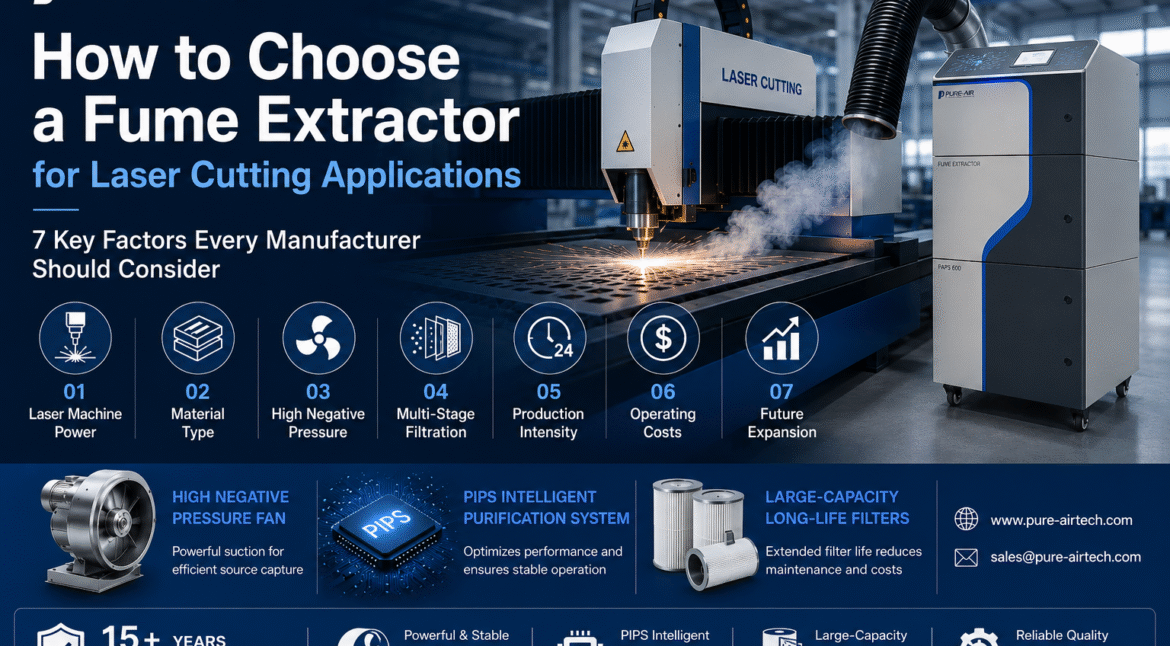
Step 3: Prioritize High Negative Pressure Instead of Airflow Alone
Many buyers only compare airflow volume (CFM or m³/h).
However, airflow alone does not guarantee efficient smoke capture.
High negative pressure is essential because it:
- Captures smoke immediately at the source
- Prevents particle dispersion
- Supports long duct runs
- Maintains stable performance
For laser cutting applications, suction capability is often more important than airflow volume.
Step 4: Choose Multi-Stage Filtration Systems
Laser cutting generates particles of various sizes.
A professional system should include multiple filtration stages.
Stage 1: Pre-Filter
Captures larger particles and protects internal filters.
Stage 2: Fine Particle Filter
Removes microscopic metal dust.
Stage 3: High-Efficiency Filter
Captures ultra-fine smoke particles.
Stage 4: Activated Carbon Filter (Optional)
Removes odors and VOCs.
Multi-stage filtration improves purification efficiency and extends filter life.
Step 5: Evaluate Production Intensity
Production schedules determine equipment requirements.
Ask these questions:
How many hours does the machine operate daily?
- 8 hours
- 16 hours
- 24-hour continuous production
How many machines operate simultaneously?
Single-machine extraction requires different configurations than centralized systems.
Step 6: Consider Future Expansion
Many factories expand production capacity over time.
Choose systems that can easily adapt to:
- Additional laser machines
- Larger workshops
- New production lines
Scalable solutions reduce future investment costs.
Step 7: Reduce Long-Term Operating Costs
The cheapest machine is rarely the most economical.
Evaluate:
Filter lifespan
Longer filter life reduces replacement frequency.
Energy efficiency
Optimized airflow lowers electricity consumption.
Maintenance requirements
Easy-access maintenance reduces downtime.
Equipment durability
Stable systems provide longer service life.
The total cost of ownership is often more important than the initial purchase price.
Why PURE-AIR Is Different
With over 15 years of manufacturing experience, PURE-AIR has developed proprietary technologies specifically for industrial air purification.
Self-Developed High Negative Pressure Fan
Provides powerful and stable suction for source capture.
PIPS Intelligent Purification System
Optimizes airflow management and filtration efficiency.
Large-Capacity Long-Life Filters
Reduce maintenance frequency and operating costs.
Customized Solutions
Suitable for:
- Fiber laser cutting
- Laser engraving
- Laser marking
- Sheet metal processing
- Automated production lines
Quick Checklist Before Buying
Before purchasing a system, ask these questions:
☑ What type of laser machine am I using?
☑ What materials am I processing?
☑ What is the laser power?
☑ How many hours does the machine operate daily?
☑ Is high negative pressure available?
☑ Does the system have multi-stage filtration?
☑ How often will filters need replacement?
☑ Can the system support future expansion?
Conclusion
Selecting the right fume extractor is essential for maintaining clean air, protecting workers, and improving production efficiency in laser cutting operations.
Rather than focusing solely on airflow volume, manufacturers should prioritize high negative pressure, advanced filtration, long-term reliability, and scalability.
With proprietary technologies and over 15 years of expertise, PURE-AIR provides customized industrial fume extraction solutions designed for the evolving demands of modern laser processing industries.