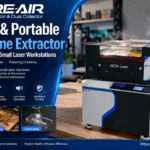
Laser Smoke Purifier vs Traditional Ventilation: Evaluating Laser Fume Control Solutions
As environmental and occupational health regulations tighten, laser processing workshops are increasingly paying attention to fume governance. Currently, common fume control methods include natural ventilation, duct exhaust, ordinary laser air purifiers, and professional industrial laser fume extractors. There are significant differences in purification effect, compliance performance, and operating costs among these solutions, and choosing the wrong scheme often leads to wasted investment and compliance risks.
1.Core Evaluation Dimensions for Laser Fume Control Solutions
A qualified laser fume control scheme should be measured against four core dimensions: purification efficiency, compliance performance, operating cost, and deployment flexibility.
Purification efficiency refers to the ability to remove particulate matter and gaseous pollutants, which directly determines the level of protection for workers and the indoor environment. Compliance performance refers to whether the scheme meets local VOC emission and occupational health standards, which is the bottom-line requirement for commercial and industrial workshops. Operating costs include equipment investment, filter replacement, and energy consumption over the full life cycle. Deployment flexibility refers to installation difficulty, space requirements, and adaptability to production layout adjustments.
Many workshops only consider upfront equipment cost when selecting a fume control scheme, ignoring long-term operating costs and compliance risks. This often leads to low initial investment but poor actual results, ultimately requiring secondary replacement and resulting in higher total costs.
2.Performance Comparison of Four Common Fume Control Schemes
Scheme 1: Natural Ventilation and Exhaust Fans
This is the most basic and low-cost scheme, relying on window ventilation or wall-mounted exhaust fans to discharge fumes. Its only advantage is low upfront cost. In terms of purification effect, it does not actually treat pollutants but only transfers them from indoors to outdoors. In terms of compliance, direct discharge of untreated VOC-containing fumes violates current fugitive emission control regulations in most regions, and there is a clear risk of penalties. In addition, fumes diffuse widely before being discharged, providing very limited protection for operators.
Scheme 2: Ducted Central Exhaust Systems
This scheme installs air ducts above workstations and uses a centralized fan to exhaust fumes outdoors. Compared with simple exhaust fans, it has better collection efficiency, but it still belongs to the category of pollutant transfer rather than purification. It still faces environmental compliance risks caused by unorganized outdoor emissions. In addition, duct installation requires modification of the workshop structure, the construction period is long, and the layout cannot be easily adjusted after installation. Long-term operation also leads to dust accumulation inside the ducts, which is difficult to clean and creates fire hazards.
Scheme 3: Ordinary Laser Air Purifiers
Ordinary indoor air purifiers filter indoor air through internal filters and do not require duct installation. However, they are designed for ambient air purification and rely on passive air circulation. They cannot capture concentrated laser fumes at the source, and most of the fumes spread into the room before being filtered. For laser processing scenarios with high fume concentration and oily components, the filter clogs very quickly, the purification efficiency decays rapidly, and the long-term filter replacement cost is high.
Scheme 4: Professional Laser Smoke Purifier Systems
A professional industrial laser fume extractor adopts source capture + multi-stage composite filtration, which is currently the scheme with the best comprehensive performance. It collects fumes directly at the processing position through a flexible extraction arm or closed hood, minimizing fume diffusion. The fumes pass through a gradient filtration system to remove particulate matter and gaseous pollutants step by step, and the purified clean air can be directly discharged indoors.
In terms of compliance, since there is no external exhaust, it naturally meets VOC fugitive emission requirements. In terms of operating costs, although the upfront investment is higher than that of simple exhaust schemes, the graded filtration design extends the service life of high-value filters, and the long-term total cost of ownership is more reasonable. In terms of deployment, stand-alone models do not require duct installation and can be moved and adjusted at any time according to production layout changes.
3.Application Scenarios for Different Types of laser fume extractors
Different types of laser fume extractors are suitable for different production scales and scenarios, and targeted selection can achieve the best cost performance.
For large industrial workshops with multiple high-power laser cutting machines, an industrial laser fume extractor with centralized pipeline design is the optimal choice. It can uniformly treat fumes from multiple stations, has high overall processing efficiency, and is equipped with intelligent control systems to adjust air volume according to actual working conditions, saving operating energy consumption.
For small and medium commercial workshops with scattered stations, stand-alone commercial laser fume extractors are more flexible. Each workstation can be independently equipped and independently controlled, and can be added or moved at any time as production expands, without affecting the normal operation of other stations.
For small studios, desktop laser engraving machines, and mobile processing scenarios, a desktop laser fume extractor or portable laser fume extractor is the most suitable option. It has a small footprint, is easy to move, and does not require installation. It can provide reliable fume purification while adapting to the characteristics of small-scale production.
4.Key Technical Indicators for Evaluating a Laser Smoke Purifier
When purchasing a laser smoke purifier, you should focus on the following core technical indicators rather than only looking at price and air volume.
First is the filtration structure and filter grade. A complete gradient filtration system is the basis for ensuring purification effect. The high-efficiency filter should reach the HEPA standard to effectively intercept ultrafine particles. The activated carbon layer should use high-iodine-value activated carbon with sufficient filling volume to ensure long-term adsorption capacity for VOCs and odors.
Second is the source capture design. The extraction arm should be flexible and positionable, able to stably stay at the optimal capture position, and the air speed at the suction hood should be within a reasonable range to ensure capture efficiency without affecting the processing process.
Third is operation and maintenance convenience. Differential pressure detection, filter life reminder, and other functions can greatly reduce management difficulty and avoid purification failure caused by untimely filter replacement. Modular filter design makes replacement faster and cleaner, reducing maintenance downtime.
Conclusion
There are essential differences in purification principle and actual effect between a professional laser smoke purifier and traditional ventilation schemes or ordinary laser air purifiers. Simple exhaust schemes only transfer pollution and cannot meet current compliance requirements. Ordinary air purification equipment is not designed for high-concentration laser fumes and has very limited actual effect.
A professional industrial laser fume extractor with source capture and multi-stage composite filtration is currently the most reliable compliant solution, whether for large industrial workshops, medium commercial processing sites, or small desktop engraving scenarios.
If you are unsure which fume control solution is suitable for your workshop, or if your existing fume treatment system cannot achieve the expected effect, our technical team can provide on-demand evaluation and targeted recommendations. Our Pure-Air product line covers industrial laser fume extractors, commercial stand-alone units, desktop laser fume extractors, and portable laser fume extractor models, adapting to almost all common laser processing scenarios. To get a professional solution design and detailed quotation, please contact our team.