n the industrial world, safety managers often find comfort in numbers. When purchasing fume and dust extractors, the focus typically gravitates toward the filter specification—specifically the high-efficiency ratings like HEPA (99.97%) or MERV 16. However, relying solely on the filter’s efficiency to protect employees is a dangerous oversight.
Even if an extractor features the world’s most advanced filter, it remains useless if the hazardous contaminants never reach it. This is the “Filtration Efficiency Trap.” In reality, the engineering of the source capture design—the hood shape, the capture velocity, and the proximity to the emission point—is the true gatekeeper of air quality. This article explores why the “front end” of your extraction system is more critical than the filter itself and provides a blueprint for optimizing capture at the source.
1. Understanding the “Capture Gap.”
The fundamental goal of any fume and dust extractor system is to prevent contaminants from entering the “breathing zone” of the operator. The breathing zone is generally defined as a hemisphere with a 300mm radius extending from the worker’s nose and mouth.
The False Sense of Security
If a welding fume extractor has a 99.9% efficient filter but only manages to capture 50% of the smoke generated at the torch, the remaining 50% bypasses the system entirely and enters the ambient air. Consequently, the worker’s actual exposure level is determined by the uncaptured 50%, not the high-efficiency filter sitting inside the machine. To ensure total protection, the design must prioritize capture efficiency over filtration efficiency.
2. The Physics of Capture: The Inverse Square Law
In the world of fluid dynamics, air velocity drops off with extreme rapidity as you move away from the suction mouth. This is the most common failure point in industrial ventilation.
The Distance Dilemma
Air velocity at the suction hood follows a principle similar to the inverse square law. For example, if you move a capture hood from 5cm away from the source to 10cm away, you do not just lose a little suction; the effectiveness can drop by as much as 75%.
-
The Result: If the hood is too far away, the “capture velocity” (the speed of air required to pull a particle into the duct) falls below the threshold needed to overcome room cross-drafts.
-
Engineering Fix: Designers must ensure that the fume and dust extractors provide sufficient static pressure to maintain the required capture velocity at the specific working distance.
3. Hood Geometry: Shaping the “Capture Zone.”
A common mistake in many workshops is using a simple open-ended pipe as a suction source. This is highly inefficient because it pulls air from all directions, including from behind the pipe, where there are no fumes.
Flanged vs. Tapered Hoods
By adding a “flange” (a flat plate) around the hood opening, you redirect the suction power. A flanged hood prevents air from being drawn from the dead zone behind the hood, focusing the suction entirely on the “front” zone where the fumes are generated.
-
Efficiency Gain: A simple flange can increase the capture velocity at a given distance by up to 25% without increasing the motor’s power consumption.
-
Enclosure Logic: Whenever possible, “booth-style” or “partial enclosures” are superior. By surrounding the source on three sides, the system requires significantly less airflow to achieve 100% capture.
4. Best Practices for Different Workstations
Not all dust and fumes behave the same way. The capture strategy must adapt to the kinetic energy of the particles being produced.
Case A: Manual Welding (High Thermal Plume)
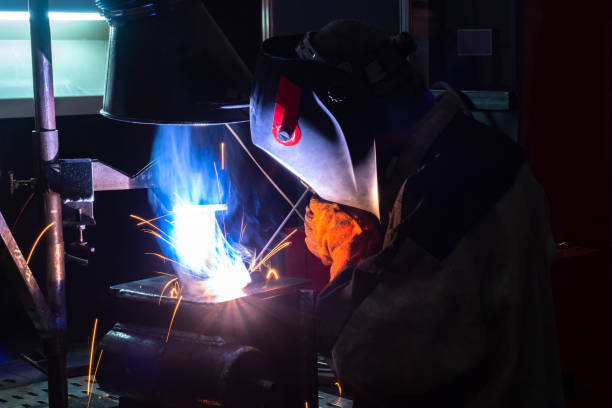
Welding fumes are hot and naturally rise. If the extractor hood is placed horizontally or poorly positioned, it fights against the natural thermal buoyancy of the fume.
-
Best Practice: Position the flexible extraction arm slightly above and behind the weld point. This utilizes the natural rise of the smoke to guide it into the hood.
Case B: Robotic Welding (Massive Volume)
Robotic cells generate a continuous, high-volume plume. A single extraction arm is often insufficient.
-
Best Practice: Use an overhead canopy hood with side curtains. This “contains” the fumes in a localized volume, allowing the fume and dust extractors to evacuate the air before it spills out into the factory floor.
Case C: Manual Grinding (High Kinetic Energy)
Unlike welding fumes, grinding dust is “thrown” at high speeds by the centrifugal force of the wheel.
-
Best Practice: The capture hood must be placed in the direct “line of fire” of the sparks. Trying to pull heavy grinding dust “upward” is energy-inefficient. Instead, use a downdraft table or a back-draft hood that catches the dust in its natural trajectory.
5. The “Three-Point” Evaluation Checklist
To avoid the “Efficiency Trap,” safety managers should evaluate their fume and dust extractors based on these three engineering criteria:
-
Capture Velocity Check: Is the air speed at the furthest point of the work area sufficient to overcome a walking person’s draft (approx. 0.5 m/s)?
-
Hood Proximity: Can the operator easily move the hood? If the extraction arm is too stiff or difficult to position, the worker will eventually push it aside and stop using it.
-
Cross-Draft Management: Are there fans or air conditioning vents blowing across the workstation? Even a perfect capture hood can be defeated by a ceiling fan that pushes the fumes away from the suction zone.
6. Advanced Features in Modern Extractors
Modern industrial systems are now incorporating “smart” features to manage the capture zone automatically.
Automatic Airflow Adjustment
Advanced fume and dust extractors use pressure sensors to detect when a filter is becoming clogged. Instead of allowing the suction (and thus the capture velocity) to drop, the system automatically ramps up the motor speed. This ensures that the worker stays protected from the first hour of the shift to the last.
Spark Arrestors
In grinding and welding applications, the capture design must also manage fire risks. Integrated spark arrestors within the capture plenum extinguish embers before they reach the flammable dust in the filter chamber. This is a critical component of “Total System Safety.”
7. Conclusion: Engineering Safety, Not Just Buying Filters
A 99% efficient filter is a vital component of any air purification strategy, but it is not a “silver bullet.” If your capture design is flawed, the filter is essentially a spectator to the pollution occurring in your facility.
True worker protection comes from a holistic approach. By focusing on hood geometry, maintaining strict capture velocities, and understanding the kinetic behavior of different contaminants, you can ensure that your fume and dust extractors do exactly what they were designed to do: remove hazards from the air before they ever reach the human lung. Don’t fall into the efficiency trap—look at the source, and build your defense from there.