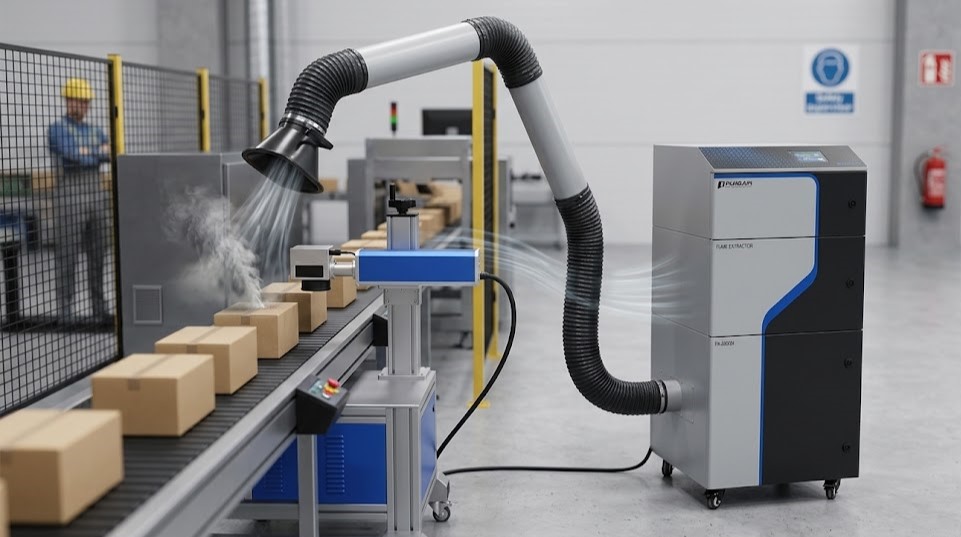
Laser coding and marking systems are the gold standard for high-speed tracking on modern packaging lines. By vaporizing plastics, metals, or organic coatings, they etch permanent lot numbers, expiration dates, and bar codes onto packaging substrates in milliseconds.
However, that highly visible laser beam also acts as a thermal reactor. It produces a dense plume of airborne hazards—including micro-fine particulates, volatile organic compounds (VOCs), and hazardous air pollutants (HAPs).
For factory compliance officers, plant managers, and operations engineers, a critical architectural question inevitably arises: Can you discharge laser coding fume directly back into the indoor factory environment? Or are you legally mandated to vent it outside through expensive exterior ductwork?
The short answer is: Yes, you can vent indoors—but only if you deploy specific, multi-stage filtration tech. Failing to implement a certified, high-efficiency configuration will cause your plant to fail its next industrial hygiene audit.
This technical guide explores the OSHA and EHS regulatory frameworks governing indoor air quality, exposes the danger of using low-grade dust bags, and profiles the exact engineering metrics required for direct indoor discharge.
1. The Regulatory Reality: What OSHA and EHS Inspectors Check
When an OSHA compliance officer or an internal Environmental Health and Safety (EHS) inspector walks onto your manufacturing floor, they don’t look at the laser marker itself; they look at the breathing zone of your machine operators.
Regulatory bodies like the U.S. Occupational Safety and Health Administration (OSHA) do not enforce rules based on machine type. Instead, they enforce strict Permissible Exposure Limits (PELs) for specific chemical and particulate compounds suspended in your indoor air:
-
OSHA PEL for Total Dust (PNOR): Capped at 15 mg/m^3 (8-hour Time Weighted Average).
-
OSHA PEL for Respirable Fraction: Restriced to a maximum of 5 mg/m^3.
-
Specific Toxic Compounds: If your laser burns PVC plastic, it generates hydrogen chloride gas, which has a strict OSHA ceiling limit of 5 ppm (7 mg/m^3). If it etches stainless steel, it releases hexavalent chromium—a known carcinogen with an action level of just 2.5 ㎎^3.
During a routine facility audit, inspectors deploy personal air sampling pumps onto your staff. If the ambient air contains concentrations above these tight limits, your facility faces heavy fines, stop-work orders, or liability claims.
2. The Failure of Fabric Bags: Why Standard Dust Collectors Cannot Protect Your Shop
A common compliance mistake made by production facilities is connecting their high-speed laser marker to a basic shop vacuum or a standard industrial fabric dust bag.
Standard dust collectors are engineered for woodworking or heavy metal grinding. They function well for large, coarse debris, but they are completely ineffective against the thermal byproducts of laser engraving.
 Traditional Fabric Dust Bag:
 [Sub-Micron Laser Fume] ───> █ Fabric Mesh █ ───> 💨 (Passes right through into the room)
                                                     *Smell remains, lungs are exposed*
-
The Particle Size Gap: Laser ablation breaks down materials at a molecular level, producing ultra-fine particles ranging from 0.1 to 1.0 micrometers (μm) in size.
-
The Ingress Trap: Standard industrial fabric filter bags can generally only capture particles down to 5 or 10 microns. Sub-micron laser particles pass right through the loose weave of a standard bag like sand through a chain-link fence.
-
The Secondary Risk: The dangerous particles are blasted right back into the room at eye level. Because these particles are small enough to bypass the human body’s natural respiratory filters (like nasal hairs), they travel deep into the alveoli of the lungs, entering the bloodstream and creating long-term health risks for your workforce.
3. The Solution: Achieving Direct Indoor Discharge via Three-Stage Filtration
To safely exhaust air directly back onto a factory floor and satisfy an EHS-compliant factory air filter audit, your facility must utilize a closed-loop system equipped with certified three-stage filtration technology.
This system must capture both sub-micron particulates and toxic molecular gases simultaneously:
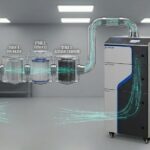
  PURE-AIR Three-Stage Closed-Loop Filter Stream:
  [Laser Plume Input] ──> [Stage 1: G4/F7 Pre-Filter] ──> [Stage 2: H13/H14 HEPA] ──> [Stage 3: Carbon Bed] ──> [Safe Indoor Return]
a. Stage 1: The Sacrificial Pre-Filter (Efficiency: F7/F9)
-
The Function: This initial block captures the large, sticky, macro-particulates (>1 μm) and heavy aerosols that could blind the more sensitive downstream filters.
-
The Purpose: It acts as a sacrificial shield, extending the operational life of your main high-efficiency core.
b. Stage 2: The HEPA Core (Efficiency: ≥ 99.99% at 0.3 μm)
-
The Function: This is the core engine of an indoor discharge smoke purifier. It must feature a certified H13 or H14 medical-grade HEPA filter.
-
The Performance Standard: According to international environmental criteria, the HEPA filter must capture a minimum of 99.99% of all airborne particulate matter down to 0.3 microns in size. This ensures that even the microscopic metal fumes and carbon soot are completely scrubbed out of the airflow.
c. Stage 3: Deep-Bed Activated Carbon Gas Phase Filter
-
The Function: HEPA filters only capture physical particles; they cannot trap gases or smells. The third stage uses an optimized bed of treated activated carbon.
-
The Performance Standard: Through a chemical process called adsorption, the massive micro-porous surface area of the carbon bed traps dangerous VOCs, formaldehyde, benzene, and toxic plastic odors at a molecular level, releasing clean, completely odorless air back into your facility.
Laser Fume Management Compliance Blueprint
| Operational Evaluation Metric | Outdoor Exhaust Ducts | Standard Dust Bags | PURE-AIR 3-Stage Closed-Loop System |
| Direct Indoor Discharge? | No (Must vent outside) | Prohibited (Fails OSHA PELs) | Yes (100% Certified Safe Return) |
| Particulate Capture Efficiency | N/A (Vents to outside atmosphere) | Poor (<40% on sub-micron soot) |
≥99.99% down to 0.3 microns |
| Gas & Odor Elimination | Disperses into the environment | Zero absorption | Excellent (Deep Activated Carbon Adsorption) |
| Facility Infrastructure Cost | High (Roof penetration, ducting) | Low (Ineffective) | Moderate (Self-contained portable footprint) |
| Environmental Permitting Required? | Yes (Requires EPA/EIA approval) | No (Fails indoor code) | No (No exterior emission profile) |
4. Capital and Regulatory Incentives for Indoor Venting
Opting for an indoor-certified laser marking fume extraction system does more than protect employee health—it offers significant financial and structural advantages for your factory layout:
-
Eliminating EPA and Environmental Impact Audits: Venting fumes through an external wall or roof line turns your factory into an active emission source. This requires you to file for complex environmental impact assessments, register with regional air pollution control boards, and undergo routine emissions testing. Indoor filtration structures bypass this regulatory barrier because they do not release process emissions into the outside atmosphere.
-
Zero Construction Footprint: Installing permanent roof-penetrating ductwork requires specialized contracting, long downtime cycles, structural roof reinforcing, and risks voiding your building’s weatherization warranties. A portable, self-contained extraction unit rolls directly into your existing production lines, connecting via flexible hoses in under ten minutes.
-
Thermal Energy Conservation: When you vent air outdoors, you are exhausting conditioned plant air. In winter or summer, your building’s HVAC system has to work harder to replace that lost air, driving up your monthly utility costs. A closed-loop indoor purifier returns cleaned, conditioned air right back into the room, reducing your factory’s overall carbon footprint.
Conclusion: Engineered for Total Factory Safety
In modern industrial automated packaging lines, air quality compliance is a core operational requirement that directly impacts your bottom line.
Stop risking your team’s health and your facility’s regulatory status on cheap, unrated dust collectors or complex, expensive external venting systems. By selecting an engineered, multi-stage laser marking fume extraction system configured with certified 99.99% HEPA and deep-bed carbon filters, you ensure your production lines easily pass demanding OSHA and EHS audits.
Explore PURE-AIR’s comprehensive lineup of portable and centralized extraction solutions today to secure clean, safe, and efficient operations for your facility.